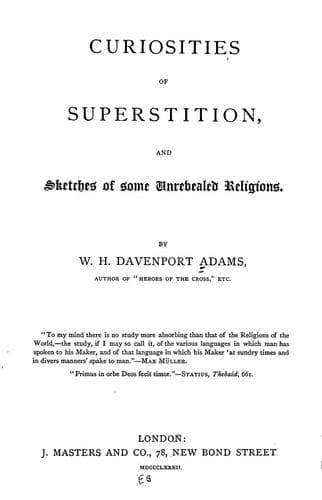
Curiosities of Superstition, and Sketches of Some Unrevealed ReligionsAdams, W. H. Davenport (William Henry Davenport)
Religion
Curiosities of Superstition, and Sketches of Some Unrevealed Religions
Adams, W. H. Davenport (William Henry Davenport)
Folklore; Religions; Superstition
“Bleeding at the touch,” has been accepted in several countries as a
revelation of guilt. A man suspected of murder was brought to the side of
the murdered man’s body, and forced to touch it; if the suspicions were
just, blood immediately oozed from the wound, or at the mouth, or nose.
Even at the man’s approach this sign of crime would appear. It is easy to
see how precarious and dangerous a test was this; how readily it might
release the guilty, and betray the innocent. Naturally therefore it was
not accepted without reluctance. A man and his sister had quarrelled; he
died suddenly, and his body was found in his own house, naked, and with a
wound on the face, but bloodless. “Although many of the neighbours in the
town came into the house to see the dead corpse, yet she, the sister,
never offered to come, howbeit her dwelling was next door, nor had she so
much as any seeming grief for his death. But the minister and bailiffs of
the town taking great suspicion of her in respect of her carriage,
commanded that she should be brought in. But when she came, she came
trembling all the way to the house; she refused to come nigh to the
corpse, or to touch, saying, that she never touched a dead corpse in her
life. But being earnestly entreated by the minister and bailiffs, and her
brother’s friends, who was killed, that she would but touch the corpse
softly, she granted to do it. But before she did it, the sun shining in at
the house, she expressed herself thus: ‘Humbly desiring, as the LORD made
the sun to shine and give light into that house, that also He would give
light in discovering that murder.’ And with these words, she touching the
wound of the dead man very softly, it being white and clean, without any
spot of blood or the like, yet immediately, while her finger was upon it,
the blood rushed out of it, to the great admiration of all the beholders,
who took it as one discovery of the murder, according to her own prayer.”
It will seem astonishing to readers of the present day that a poor
creature’s life could be taken away on such fanciful and uncertain
evidence.
We read that a Sir James Standsfield was found lying dead in a stream. His
body was interred precipitately. Two days afterwards it was exhumed and
partially dissected, the neck in particular being laid open, in order to
ascertain the cause of death. After being well cleansed, blood burst from
that side supported by his son Philip, on returning the body to the coffin
for re-interment--not an unlikely result from the straining of the
incisions--and it deeply stained his hand. He was arraigned, on this
slight ground, for parricide; and in the course of the trial it was
gravely argued that it was the will of Providence to disclose by this
peculiar incident a secret crime.
* * * * *
Public-domain text, read in full here on John Shaqi.
Reviews
Reviews
No reviews yet
Be the first to share your thoughts on this work.
Elsewhere in the archive
Join the Discussion
Join the discussion
Sign in to leave a comment or review.
Sign InorCreate an account