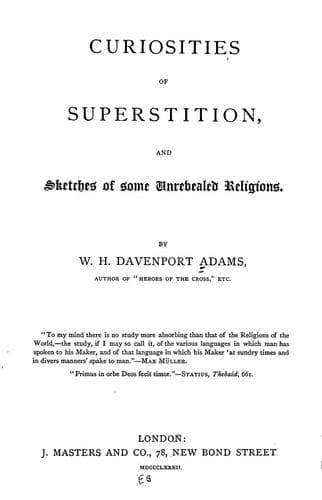
Curiosities of Superstition, and Sketches of Some Unrevealed ReligionsAdams, W. H. Davenport (William Henry Davenport)
Religion
Curiosities of Superstition, and Sketches of Some Unrevealed Religions
Adams, W. H. Davenport (William Henry Davenport)
Folklore; Religions; Superstition
Munro, the Scotch soldier of fortune, who bore himself so gallantly in the
wars of Gustavus Adolphus, tells a story of a vision that was seen by a
soldier of his company on the morning of the storm of Stralsund in 1628.
One Murdo Macleod, born in Assen, a soldier of tall stature and valiant
courage, being sleeping on his watch, awoke at break of day, and “jogged”
two of his comrades lying by him, much to their indignation at his
“stirring them.” He replied: “Before long, you shall be otherwise
stirred.” A soldier called Allan Tough, a Lochaber man, recommending his
soul to GOD, asked him what he had seen: “That you shall never behold your
country again.” The other replied, the loss was but small, if the rest of
the company were well. He answered: “No, for there was great hurt and
dearth of many very near.” The other again asked, what others he had seen
who would perish. He then told by name sundry of his comrades who would be
killed. The other asked, what would become of himself. Eventually, he
described by their clothes all the officers who would be hurt. “A pretty
quick boy near by,” asked him, what would become of the Major (that is,
Munro himself?) “He would be shot, but not deadly,” was the answer,--and
so it proved.
A good deal is said of this _Taisch_, or “Second Sight,” in Dr. Johnson’s
“Journey to the Hebrides,” and some striking anecdotes are told. It was
just the thing to interest his moody temperament, with its terrible dread
of death and its longing to lift the curtain that hides from us the
Unseen. He seems, however, to have been unable to convince himself of the
actual existence of such a power; all the evidence he could collect failed
to advance his curiosity to conviction, so that he could not believe,
while remaining willing to believe. To use the noble words of Goethe,
nobly rendered by Coleridge:
“As the sun,
Ere it is risen, sometimes paints its image
In the atmosphere, so often do the spirits
Of great events stride on before the events,
And in To-day already walks To-morrow.”
_This_ it is not difficult to accept. It seems fitting that presages
should herald the death of kings and the revolutions of nations; but the
mind cannot convince itself that the spirits of the dead will cross the
shadowy borders to foretell the trivial accidents that chequer ordinary
lives. Yet, as Johnson says: “A man on a journey far from home falls from
a horse; another who is perhaps at work about the house, sees him bleeding
on the ground, commonly with a landscape of the place where the accident
befalls him. Another seer, driving home his cattle, or wandering in
idleness, or musing in the sunshine, is suddenly surprised by the
appearance of a bridal ceremony or funeral procession, and counts the
mourners or attendants, of whom, if he knows them, he relates the names,
if he knows them not he can describe the dresses.”
Public-domain text, read in full here on John Shaqi.
Reviews
Reviews
No reviews yet
Be the first to share your thoughts on this work.
Elsewhere in the archive
Join the Discussion
Join the discussion
Sign in to leave a comment or review.
Sign InorCreate an account