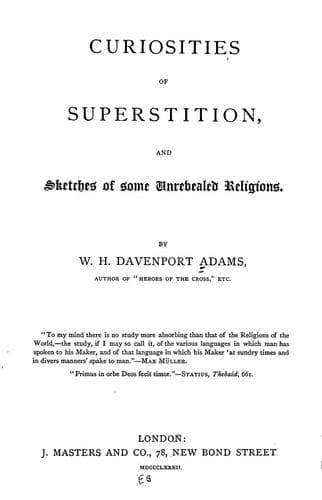
Curiosities of Superstition, and Sketches of Some Unrevealed ReligionsAdams, W. H. Davenport (William Henry Davenport)
Religion
Curiosities of Superstition, and Sketches of Some Unrevealed Religions
Adams, W. H. Davenport (William Henry Davenport)
Folklore; Religions; Superstition
Ceremonies of a more fantastic character were sometimes involved, and
round the novice’s body was coiled a hair rope with which a corpse had
been bound to its bier. He was then required to look through a hole left
by the removal of a fir knot; and, on stooping, he was instructed to look
back between his legs, until an advancing funeral procession should cross
the boundary of the estates of two different owners. The inconvenience of
this complicated performance is obvious; it might also be dangerous; for
if the wind changed while the novice was girded with the mystical cord, he
was liable to the penalty of death.
A seer gifted with this wonderful faculty could not divest himself of it,
though often he would fain have done so. However acquired, it was a
perilous endowment, fraught with physical and mental suffering, and
reputed to be no gift from on high, but to have come from the Father of
Evil.
The objects seen were generally sad and sorrowful; calamities to persons
or nations. Woodrow says that before the Marquis of Argyll went to London
in 1660, he was playing “at the bullets,” or bowls, with some Scottish
gentlemen; when one of them, as the Marquis stooped down to lift the
bullet, “fell pale,” and said to those about him: “Bless me, what is this
I see? my lord with his head off, and all his shoulder full of blood?”
On one occasion, a gentleman joined a company, all of whom were very frank
and cheerful. He had no sooner entered than one of the guests, who had not
previously known him, showed much depression of spirit. Without taking any
notice of it the new-comer quickly rose, and went his way. The other
thereupon showed great concern, and wished he would remain; for he saw
him, he said, with a shroud up to his neck, and he knew that this sign
foreboded his death. In vain some of the company would have persuaded the
doomed man to take warning, but he departed, and having ridden a short
distance, he and his horse fell, and he broke his neck.
On the morning of the battle of Bothwell Bridge, that sore defeat to the
Covenanters--so vigorously described by Scott in his “Old Mortality”--Mr.
John Cameron, minister at Lochhead in Kintyre, fell into a fit of
melancholy, so that Mr. Morison, of his elders, observing him through his
chamber door, sore weeping and wringing his hands, knocked until he opened
to him. Then he asked what was the matter? Were his wife and children
well? “Little matter for them,” he answered; “our friends at Bothwell are
gone.” Mr. Morison told him it might be a mistake, and the offcome of his
gloomy thoughts: “No, no,” said he, “I see them flying as clearly as I see
the wall.” As near as they could calculate by the accounts they afterwards
obtained, this incident at the Lochhead of Kintyre was contemporaneous
with the flight of the Covenanters at Bothwell.
Public-domain text, read in full here on John Shaqi.
Reviews
Reviews
No reviews yet
Be the first to share your thoughts on this work.
Elsewhere in the archive
Join the Discussion
Join the discussion
Sign in to leave a comment or review.
Sign InorCreate an account