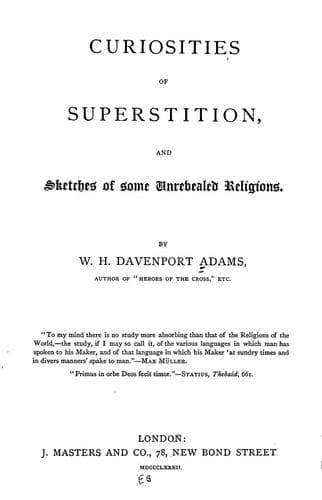
Curiosities of Superstition, and Sketches of Some Unrevealed ReligionsAdams, W. H. Davenport (William Henry Davenport)
Religion
Curiosities of Superstition, and Sketches of Some Unrevealed Religions
Adams, W. H. Davenport (William Henry Davenport)
Folklore; Religions; Superstition
From “second sight” we pass on to “prediction” or “divination,” another of
the superstitious modes by which humanity has endeavoured to read the book
of the Future. In the north this power of prophecy was largely assumed by
women, a circumstance of which Scott has made ample and picturesque use in
more than one of his admirable fictions.
A woman foretold the tragical end of James I. of Scotland, in 1436. In the
early stage of a journey from Edinburgh to Leith, and in the midst of the
way, arose a woman of Ireland, who claimed to be a soothsayer, and as soon
as she saw the king, she cried with a loud voice, saying, “My lord king,
an ye pass this water, ye shall never turn again to live.” The king was
astonished at her words, for but shortly before he had fallen in with a
prophecy, that in the self-same year the King of Scots should be slain.
And as he rode onward, he called to him one of his knights, and commanded
him to return and speak with this woman, and ask of her what she would,
and what she meant by her loud crying: and she began and told him what
would befall the king if he passed that water. The king asked her how she
knew so much, and she said that Huthart told her so. “Sire,” quoth the
knight, “men may gallantly talk, nor take heed of yonder woman’s words,
for she is but a drunken fool, and wots not what she saith.” And so with
his folk he passed the water called the Scottish Sea, towards S. John’s
town [Perth,] about four miles from the country of the wild Scots, and
there, in a convent of Black Friars, outside the town, he held a great
feast. In the course of the revel came “the said woman of Ireland, who
called herself a divineress,” and made several vain attempts to gain
access to the king. Meanwhile the conspirators matured their plot, removed
the king’s guards, attacked him, and slew him.[70]
Public-domain text, read in full here on John Shaqi.
Reviews
Reviews
No reviews yet
Be the first to share your thoughts on this work.
Elsewhere in the archive
Join the Discussion
Join the discussion
Sign in to leave a comment or review.
Sign InorCreate an account