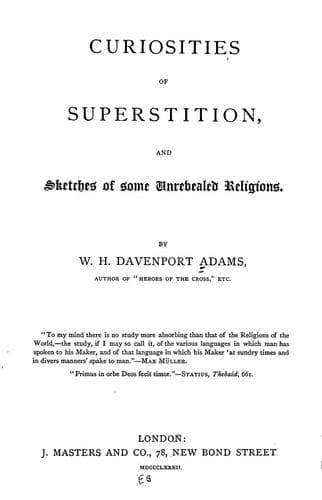
Curiosities of Superstition, and Sketches of Some Unrevealed ReligionsAdams, W. H. Davenport (William Henry Davenport)
Religion
Curiosities of Superstition, and Sketches of Some Unrevealed Religions
Adams, W. H. Davenport (William Henry Davenport)
Folklore; Religions; Superstition
All the predictions which come true are preserved; we hear nothing of
those which fail, for no one has an interest in recording or repeating
them; hence an undue importance is gradually attached to what are nothing
more than remarkable coincidences. Many others are prophecies “after the
event.” Others are based on a careful calculation of probabilities. As in
the following example: An Orkney warlock, full of displeasure with James
Paplay, a proud and haughty chief, with whose character, doubtless, she
was well acquainted, broke forth into a torrent of predictive utterances:
“Thou art now the highest man that ever thou shalt be! Thou art gone to
shear thy corn, but it shall never do you good! Thou art going to set
house with thy wife,--ye shall have no joy of one another. Oil shall not
keep you and her; ye shall have such a meit-will [craving,] and shall have
nothing to eat, but be fain to eat grass under the stones and wair
(sea-weed) under the rocks.” It was seriously asserted that not only were
these predictions--or menaces--uttered, but that they were all fulfilled;
and it is possible that the prophet may have had something to do with
their fulfilment.
A curious anecdote is related of a Scottish minister, who, on the day of
the battle of Killiecrankie, was preaching at Anworth, and in his preface
before his prayer, according to his usual mode of homely expression, began
to this purpose: “Some of you will say, What news, minister? What news
about Clavers, who has done so much mischief in this country? That man
sets up to be a young Montrose, but as the LORD liveth, he shall be cut
short this day. Be not afraid,” added he, “I see them scattered and
flying: and as the LORD liveth, and sends this message by me, Claverhouse
shall no longer be a terror to GOD’S people. This day I see him
killed--lying a corpse.” And on that day, and at that hour, Claverhouse
fell[71] (July 27th, 1689.)
In their anxiety to obtain a glimpse of the dread writing in the Book of
Fate, men have resorted to divers strange expedients, applying to warlocks
and witches, or seeking to wring a response to their questionings from the
creatures of the Invisible World. The ceremony known as _Taghairm_, or
“Echo,” seems to have been peculiar to Scotland. The inquirer was wrapped
in a cow’s hide, his head being left free, and was carried by assistants
to a solitary spot, or left under the liquid arch formed by the “sheeted
column’s silvery perpendicular” in waterfall or cataract: there he
remained during the watches of the night, with phantoms fluttering round
about him, from whence he was supposed to derive the burden of the
oracular response he delivered to his comrades on the following day.
Public-domain text, read in full here on John Shaqi.
Reviews
Reviews
No reviews yet
Be the first to share your thoughts on this work.
Elsewhere in the archive
Join the Discussion
Join the discussion
Sign in to leave a comment or review.
Sign InorCreate an account