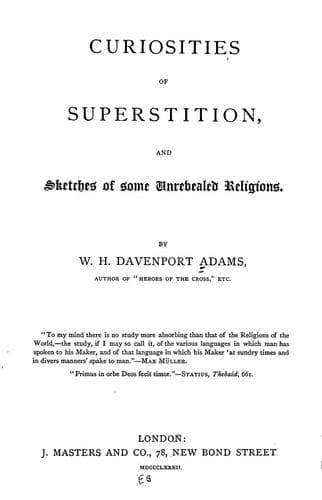
Curiosities of Superstition, and Sketches of Some Unrevealed ReligionsAdams, W. H. Davenport (William Henry Davenport)
Religion
Curiosities of Superstition, and Sketches of Some Unrevealed Religions
Adams, W. H. Davenport (William Henry Davenport)
Folklore; Religions; Superstition
Kirk, the Scotch minister of Aberfoyle, who died in 1688, relates some
other particulars of the “good people.” Their substance, he says, is
denser than air; too subtle to be pierced, and, like that of Milton’s
angels, reuniting when divided, or when any attempt is made to cleave it
asunder. Their voice is like unto whistling. They change their places of
abode every quarter of the year, floating near the surface of the earth;
and persons gifted with the second sight have often had fierce encounters
with them. The Highlanders, to preserve themselves and their cattle
against them, went regularly to church on the first Sunday of every
quarter, though they might not return during the interval. At the name of
GOD or JESUS they vanished into thin air. They were of both sexes, and
like mankind, they were mortal.
“Some meagre allusions appear to the Queen of the Fairies, and especially
by King James, whose immediate knowledge may have been derived from the
vignettes in Olaus Magnus, and the words of his own unhappy subjects, who
perished on account of their credulity. Alexoun Perisoma was convicted, on
her confession, of repairing to the ‘queen of Elfame,’ with whom she was
familiar. Jean Wire (1670) declared that, while she taught a school at
Dalkeith, a woman desired to be employed ‘to speik to the Queen of Fairie,
and strike ane battell in hir behalf with the said Queen.’” The name of
Titania is familiar enough to all lovers of English literature. There was
a necromancer or wizard, in the reign of Charles I., who affirmed he had
an incantation--“O Micol, Micol, regina Pigmiorum, veni,”--that Titania
could not resist. Lilly tells us that when it was tested at Hurst wood,
first a gentle murmurous sound was heard; then rose a violent whirlwind,
which swelled into a hurricane; and lastly the Fairy Queen appeared in all
her radiance.
Fairies generally dwelt in subterraneous abodes; in the interiors of
grassy hillocks, whence issued dulcet sounds and flashes of weird light;
sometimes the side of a hill opened, and exposed them to the gaze of the
belated wayfarer. No doubt they were seen everywhere by the potent gaze of
imagination; on the meads and in the groves, or curled up among the
bending flowers; for
“Visions as poetic eyes avow,
Hang from each leaf, and cling to every bough.”
They were reputed to be well skilled in the medical art, and to favoured
mortals they sometimes imparted their knowledge. It is difficult to
understand why they were credited with the abstraction of children, and
with the substitution of other beings in their place. For this curious
kind of theft was commonly attributed to them. A “wise woman”--a dealer in
simples and herbal potions--having failed to cure a child, declared that
“the bairn had been taken away, and an elf substituted.”
Besides the fairies, Scotland could boast of its spirits of the waters,
just as Germany had its Loreleys and Ondines.
Public-domain text, read in full here on John Shaqi.
Reviews
Reviews
No reviews yet
Be the first to share your thoughts on this work.
Elsewhere in the archive
Join the Discussion
Join the discussion
Sign in to leave a comment or review.
Sign InorCreate an account