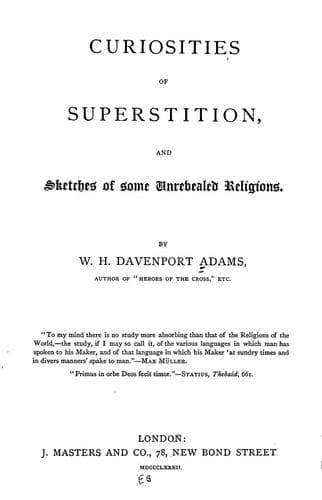
Curiosities of Superstition, and Sketches of Some Unrevealed ReligionsAdams, W. H. Davenport (William Henry Davenport)
Religion
Curiosities of Superstition, and Sketches of Some Unrevealed Religions
Adams, W. H. Davenport (William Henry Davenport)
Folklore; Religions; Superstition
If a certain worm in a medicinal spring on the top of a hill in Strathdon,
were found alive, it was a sign that the patient would live; and in a well
of Ardwacloich, in Appin, if the patient were to die, a dead worm was
found in it, and a live one, if he were to recover. In the district of
Lorn, the figures assumed by an egg dropped into water were supposed to
indicate the appearance of a future spouse. “Also, one of four vessels
being filled with pure, and another with muddy water, the third with milk,
and the fourth with meal and water; if the diviner blindfold dips his hand
in the first, it augurs that his spouse shall be led to the nuptial couch
in all her pristine purity; but otherwise if dipping in the second: if
finding his way to the milk, a widow shall fall to his lot; and an old
woman awaits him from the meal and water. Three vessels are used in the
south of Scotland; one of them empty; and should fate direct the diviner
hither, it augurs perpetual celibacy.”
* * * * *
A belief in Fairies was widespread, and has survived, in remote districts,
down even to our own time:
“Oft fairy elves
Whose midnight revels by a forest side
Or fountain, some belated peasant sees,
Or dreams he sees, while overhead the moon
Sits arbitress, and nearer to the earth
Wheels her pale course, they on their mirth and dance
Intent, with jocund music charm his ear:
At once with joy and fear his heart rebounds.”[73]
It is not easy to reconcile the conflicting details of the disposition,
manners, habits, and influence of these liliputian spirits which we meet
with in the early writers. But on a general survey it appears that they
were very diminutive; in their intercourse with mortals sometimes
good-tempered, sometimes malignant; that they loved and married, and had
offspring; that they were very merry, and loved to dance upon the green,
and fill the air with choral music; that they possessed stores of gold and
silver, which they distributed freely; that they were invisible, but could
at will present themselves to mortals; that they were very timid, and
would inflict a summary punishment upon intruders. Their influence was at
its highest on Friday, at noon, and at midnight.
Public-domain text, read in full here on John Shaqi.
Reviews
Reviews
No reviews yet
Be the first to share your thoughts on this work.
Elsewhere in the archive
Join the Discussion
Join the discussion
Sign in to leave a comment or review.
Sign InorCreate an account