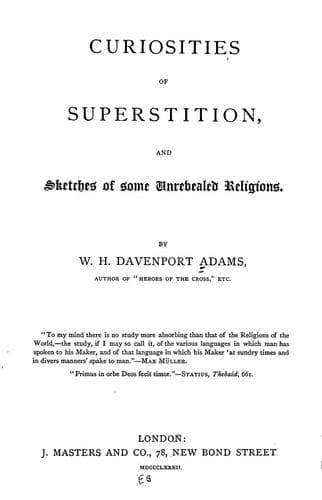
Curiosities of Superstition, and Sketches of Some Unrevealed ReligionsAdams, W. H. Davenport (William Henry Davenport)
Religion
Curiosities of Superstition, and Sketches of Some Unrevealed Religions
Adams, W. H. Davenport (William Henry Davenport)
Folklore; Religions; Superstition
Now it seems necessary to correct a popular error, that the Zendavesta is
largely liturgical: an error confirmed by the assertion of Gibbon, who
says: “Every mode of religion, to make a deep and lasting impression on
the human mind, must exercise our obedience, by enjoining practices of
devotion for which we can assign no reason; and must acquire our esteem by
inculcating moral duties analogous to the dictates of our own hearts. The
religion of Zoroaster was abundantly provided with the former, and
possessed a sufficient portion of the latter.” But Zarathustra himself, in
one of his best-known precepts, warns his followers that “he who sows the
ground with care and diligence, acquires a greater stock of religious
merit than he would gain by the repetition of ten thousand prayers.” It is
the tendency of all ethico-religious systems, at least in their earliest
stage of development, to discourage purely liturgical observances, and to
enjoin on the disciple a state of self-concentration and self-absorption
varied only by physical activity. Unaided by a divine Revelation, their
founders never rise higher than the passive virtues of endurance and
patience. As time passes away, and the new creed falls into the hands of a
special school of expounders, minute rites and rigid practices are
accumulated in order to impose upon the neophyte, and deepen the influence
of those who alone possess a clue to their meaning. The formalities which
encumber the Zarathustrian worship were invented long after the death of
the master, and no indication of them appears in the oldest section of
the Zendavesta. They are to be found chiefly in the much later pages of
the _Sadder_, where fifteen different genuflexions and prayers are
required of the devout Persian every time he cuts his finger-nails!
To return to the Yasna. The Gâthas, of which we have been speaking, were
not improbably composed by Zarathustra himself, and may be held to express
his belief and his thoughts in his own words. The second part, or “Younger
Yasna,” is of a much later date and less lofty tone. The invention of some
of the Master’s disciples or priests, it re-establishes the Polytheism
which Zarathustra so strenuously condemned; and furnishes the believer
with a manual of prayers and incantations (in prose) to the genii of the
woods and streams and hills, the powers of fire and earth and water, and
all the invisible spirits which haunt the luminous air.
We come next to the _Visparad_, a collection of prayers in
three-and-twenty chapters, written in Zend, and of a similar tenour to
those in the younger Yasna. These prayers refer to the preparation of the
sacred water, and the consecration of certain offerings--such as the
sacred bread--which are carried round about the sacred fire, and after
having been exhibited to it, are eaten by the priest and by the votary on
whose behalf the ceremony is performed.
Public-domain text, read in full here on John Shaqi.
Reviews
Reviews
No reviews yet
Be the first to share your thoughts on this work.
Join the Discussion
Join the discussion
Sign in to leave a comment or review.
Sign InorCreate an account