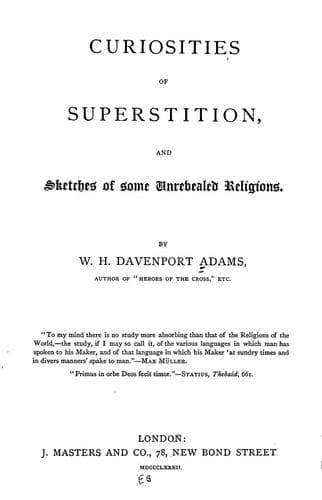
Curiosities of Superstition, and Sketches of Some Unrevealed ReligionsAdams, W. H. Davenport (William Henry Davenport)
Religion
Curiosities of Superstition, and Sketches of Some Unrevealed Religions
Adams, W. H. Davenport (William Henry Davenport)
Folklore; Religions; Superstition
His happiness, like His holiness, is without spot or blemish; every
blessing is His that man can imagine--health and wealth, virtue, wisdom,
prosperity, immortality; and these blessings He is willing to bestow on
His creatures if in thought and word and deed they eschew impurity. But we
nowhere read that He will assist them in the struggle against sin by
creating in them a new heart, or by vouchsafing the grace of His Holy
Spirit. The mystery of the Atonement was beyond the reach of the soul and
intellect even of Zarathustra; and the highest conception of God to which
he could attain was that of a Being of perfect Goodness, sitting enthroned
in a strange awful loneliness, with no other feeling than that of approval
of Good and disapproval of Evil. He is, of course, the supreme type of
Power: all that _is_ flows from Him, as light from the Sun: He creates
both the shadow and the brightness of the human existence, good and ill,
fortune and misfortune. So far above all human intelligence is He placed,
that images of Him are forbidden, though He is understood to be symbolised
by the sun and by fire. He can be served only by prayers and offerings, by
a life of purity and truth, by abstinence from sinful passions, by the
banishment of sinful thoughts. Thus Herodotus says of the Zarathustrians,
that they reject the use of temples, of altars, and of statues. “They
smile,” he says, “at the folly of those nations who imagine that the Gods
are descended from, or have any affinity with, human nature. The loftiest
mountain-tops are the places chosen for their sacrifices. Hymns and
prayers are their principal forms of worship. And the Supreme God, who
fills the vast sphere of Heaven, is the object to whom they are
addressed.”
The service of Ahura-Mazda consisted, then, as we see, in the performance
of good works, in the cultivation of virtue, and in the due offering up of
prayer and praise. It was an intellectual worship that Zarathustra
prescribed; a worship that might assist in the development of a high
morality, but could not inculcate a deep and true religious feeling. Of
contrition for sin, of humbling oneself before God, of self-sacrifice and
self-abnegation, of love, and faith, and hope, the creed of Zarathustra
took no account. And here, as well as elsewhere, we observe its vast
inferiority to the religion of CHRIST. It made no provision for the
awakening and fostering of those tender emotions of profound humility,
thankful adoration, and unutterable gratitude which are awakened in the
Christian’s heart by the name of JESUS. It could never have called forth
such an utterance of the son’s glad submission to the will of the FATHER
as we find, for example, in the ejaculatory verse of Ben Jonson:
“Hear me, O GOD!
A broken heart
Is my best part:
Use still Thy rod,
That I may prove
Therein Thy love.
“If Thou hadst not
Been stern to me,
But left me free,
I had forgot
Myself and Thee.
Public-domain text, read in full here on John Shaqi.
Reviews
Reviews
No reviews yet
Be the first to share your thoughts on this work.
Join the Discussion
Join the discussion
Sign in to leave a comment or review.
Sign InorCreate an account