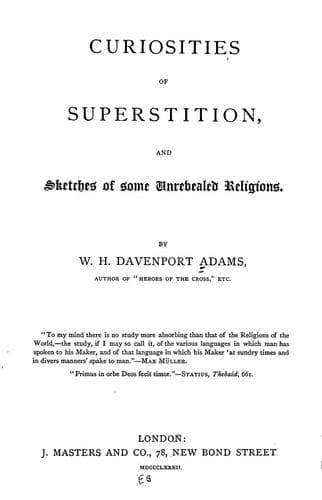
Curiosities of Superstition, and Sketches of Some Unrevealed ReligionsAdams, W. H. Davenport (William Henry Davenport)
Religion
Curiosities of Superstition, and Sketches of Some Unrevealed Religions
Adams, W. H. Davenport (William Henry Davenport)
Folklore; Religions; Superstition
It is certain that the grand and lofty Hebrew revelation of the One GOD
was modified and debased by its contact with the Magian teaching. It has
been well remarked that wherever any approximation had been made to this
sublime truth of the existence of the one great First Cause, either “awful
religious reverence” or “philosophic abstraction” had removed the Creative
Power absolutely out of the range of human sense, and supposed that the
intercourse of the Divinity with man, the moral government, and even the
actual creative work, had been carried on by the intermediate agency of,
in Oriental phrase, an Emanation, or, in Platonic language, of the
“Wisdom,” “Reason,” or “Intelligence” of the Supreme. The Jews, under the
influence of their intercourse with the Persians, adopted that conception,
and, departing from the path laid down for them by Revelation, interposed
one or more intermediate beings as the channels of communication between
GOD and man. The Apostle seizes on the popular fancy, and endeavours to
restore from it the original truth, when he tells his readers that the
“Word” of which they spoke so vaguely and presumptuously was none other
than GOD Himself,--the SON of GOD, but equal with the FATHER,--the
brightness of His glory and the express image of His person. He showed
them that the mediation between the lofty spiritual nature of GOD and the
intellectual and moral being of Man was not to be accomplished through any
independent agency, but by the revelation of GOD Himself in the person and
presence of His beloved SON. That this, the essential and central truth of
Christianity, was one which the unassisted human intellect could never
have developed we know, from the fact that it is found in no creed of
admittedly human origin, and that it is never clearly set forth even in
any religious system which has borrowed from Christianity.
We can imagine the ability of man to shape out for himself an idea of some
awful Power, some mighty First Cause, which created and ordered the
universe, and controlled and shaped its destinies. Looking around upon
creation, he might, perhaps, without any severe intellectual effort,
attain to the thought of a Creator. This conception once realised, he
might in due time come to believe that the Creator could be pleased or
angered by the doings of His creatures; and that the anger of One so
powerful would be something to dread and avoid. But the idea of this grand
and terrible Creator sending from Heaven His own Son to take upon Himself
humanity, and thereby save the creature from the just wrath it had
provoked, and the dread retribution it had deserved,--an idea, so glorious
and consoling, could never, we believe, have been grasped by the loftiest
human intellect, unless aided by a revelation from above.
Public-domain text, read in full here on John Shaqi.
Reviews
Reviews
No reviews yet
Be the first to share your thoughts on this work.
Join the Discussion
Join the discussion
Sign in to leave a comment or review.
Sign InorCreate an account