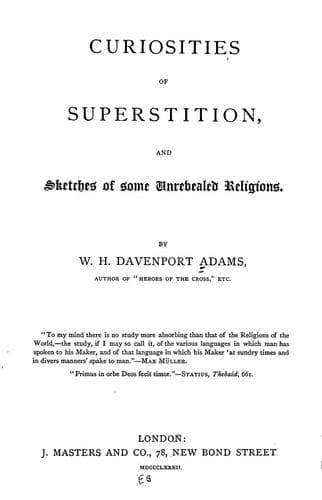
Curiosities of Superstition, and Sketches of Some Unrevealed ReligionsAdams, W. H. Davenport (William Henry Davenport)
Religion
Curiosities of Superstition, and Sketches of Some Unrevealed Religions
Adams, W. H. Davenport (William Henry Davenport)
Folklore; Religions; Superstition
_d._ Decisions of the wise, given by them as “hedges of the law;” and
_e._ Counsels of prudence, which it was well to follow, though they
had no legal authority.
The Haggadic narratives are generally of a light and amusing character,
though occasionally a deep significance underlies them, converting them
into allegories and fables and parables well worthy the attention of the
student, though he may not think so highly of them as Frankel, who
exclaims: “They are as vivid flashes: or as those spirits of light in
Jewish myth, that flow forth in daily myriads from GOD’S throne, and then
vanish to make way for others.”
The Halacoth and Haggadoth accumulated rapidly after the Captivity,
representing in due time “a body of traditional exposition of high
authority, which increased rapidly, and required the life-long study of a
numerous body of Sopherim, or Scribes, to digest and hand on without loss
to succeeding generations.” Soon it outgrew the grasp of even the
strongest memory and the profoundest application, and it became evident
that, unless put upon record, all that was valuable would perish, and only
that be preserved which chanced to be in accordance with popular
sentiment. To the digest made by Hillel, Simon ben Gamaliel added the
worthiest of the later material; and his son, Jehudah the Holy, entered on
a complete redaction and revision, which he published in A.D. 219. Hillel,
grandfather of the Gamaliel at whose feet S. Paul sat, had arranged the
traditional Halacoth under eighteen heads; Jehudah re-arranged them into
six Sedarim, or sections:--
1. _Zeraïm_ (Seeds,) on Agriculture;
2. _Moed_ (Feast,) on the Sabbath, Festivals, and Fasts;
3. _Nashim_ (Women,) on Marriage, Divorce, &c., including the laws on
Vows and the Nazirship;
4. _Nizikin_ (Damages,) chiefly civil and penal law, including the
ethical treatise Aboth;
5. _Kadashim_ (Sacred things,) Sacrifices, &c., a description of the
Temple at Jerusalem, &c.;
6. _Tehoroth_ (Purifications,) on pure and impure persons and things.
We now see that, about A.D. 221 Jehudah the Holy created the Mishna, we
have already seen that three centuries later, the same exhaustive work of
redaction and revision was done for the Gemara,--the two forming what is
now known as the Talmud. The two “editors” received each his peculiar
title of honour; Jehudah was styled Rabbina, Ashi Rabban.
Public-domain text, read in full here on John Shaqi.
Reviews
Reviews
No reviews yet
Be the first to share your thoughts on this work.
Elsewhere in the archive
Join the Discussion
Join the discussion
Sign in to leave a comment or review.
Sign InorCreate an account