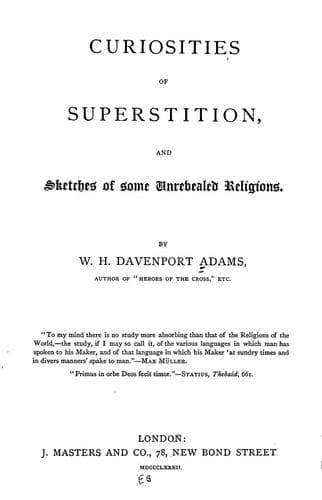
Curiosities of Superstition, and Sketches of Some Unrevealed ReligionsAdams, W. H. Davenport (William Henry Davenport)
Religion
Curiosities of Superstition, and Sketches of Some Unrevealed Religions
Adams, W. H. Davenport (William Henry Davenport)
Folklore; Religions; Superstition
Of the language of the Babylon Talmud it is said that it is debased with
foreign and barbarous terms and grammatical solecisms to a much greater
extent than the “Jerusalem Talmud.” Mr. Blunt asserts that “the Haggadic
narratives resemble more closely the vernacular Aramaic, showing their
origin in ordinary folk lore. The Halacoth are in Mishnic Hebrew, carrying
evidence of higher date. The style is so exceedingly concise as to make
the sense that it contains a microscopic study. The difficulties indeed
of the Gemara are so great, that no one need think to master them
thoroughly who has not drawn in Gemara with his mother’s milk. The study
of the Talmud presumes a thorough knowledge also of the Hebrew Bible, a
single word often indicating an entire passage. The wonderful moral
confusion of the Talmud, the mixed character of which may be detected in
every page, is nowhere more strikingly exemplified than in the prayer put
by the Gemarist into the mouth of Rabbi Nechoniah ben Hakakana, on
entering the school, or Beth Midrash, and quitting it again in the
evening.”
The morning prayer was as follows:--
“I beseech Thee that no scandal may occur through fault of mine, and that
I err not in matters of Halacah, so as to cause my colleagues to exult.
May I not call impurity pure, or purity impure; and may my colleagues not
blunder in matters of Halacah, that I may have no cause to triumph over
them.”
The spirit of this prayer, in its meekness and modesty, is truly
commendable, and presents a striking contrast to that of the evening
prayer:--
“I thank Thee that Thou hast given me my portion among those who have a
seat in the Beth Midrash, and that Thou hast not cast my lot among those
who sit in the corner. I early rise, and they early rise; but I rise to
the service of the law, they to vanity. I labour, and they also labour,
but I labour and receive a recompense; they labour, but receive nothing. I
hasten, and they also hasten; but I hasten in the direction of the world
to come, they hasten towards the pit of destruction.”
It is impossible to believe that both these prayers come from the same
source; “sweet waters and bitter” do not alike flow from the fountain of
Marah.
With respect to the general character of the Talmud, with all its weakness
and strength, its beauty and deformity, its poetry and commonplace, its
tender wisdom and glaring absurdity, we cannot do better than quote the
moderate opinion of the writer already cited, as infinitely more
trustworthy than the dithyrambic utterances of Deutsch and his imitators.
He says:--
Public-domain text, read in full here on John Shaqi.
Reviews
Reviews
No reviews yet
Be the first to share your thoughts on this work.
Elsewhere in the archive
Join the Discussion
Join the discussion
Sign in to leave a comment or review.
Sign InorCreate an account