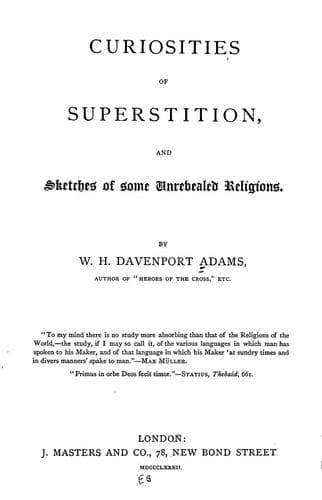
Curiosities of Superstition, and Sketches of Some Unrevealed ReligionsAdams, W. H. Davenport (William Henry Davenport)
Religion
Curiosities of Superstition, and Sketches of Some Unrevealed Religions
Adams, W. H. Davenport (William Henry Davenport)
Folklore; Religions; Superstition
“In its origin it was the result of an almost necessary development.
Starting with the axiom that the law of Moses is binding on the children
of Abraham in every generation, its precepts have been applied to the
changing habits and customs of the Jews in different ages and under
various climates, by a literal interpretation when possible, otherwise on
the _ci-près_ principle, rarely by giving a new direction to its
enactments, as instanced under the Hillel _régime_. It is this application
of the Law to the needs of Jewish Society, by a process slow and gradual,
that has made each successive stage of development, in Jewish opinion,
more valuable than its predecessors. Thus if the Law has been likened to
water, the Mishna, which gives a later direction to its precepts, is as
wine; and the Gemara, declaring as it does the sense in which the Mishnic
Hilkoth are to be taken, is as hippocras. It is not that the Law is less,
or that the traditional decisions and expository matter are more sacred,
but the latest phase of judicial interpretation is the most binding; and
where the rule of action is clear and decisive, no antecedent utterance
need trouble the inquirer. Yet the Talmud has always been antiquated. It
has never known the sunshine of youth. It has still been the mouldering,
moss-grown ruin. In its origin it presupposed vital action where there was
nothing but death; Temple service with the Temple hopelessly in ruins,
‘not one stone upon another;’ sacrificial rites that were impossible
without an altar, and for which certain prayers were substituted,
carefully numbered out, and made binding on the individual in lieu of
public offering.... Nothing can be more completely out of place than
strict Talmudism amid the complications of modern society; it is
impossible to make its precepts consist with the social and political
duties of the highly educated Jew. Our LORD, Who came not to destroy the
Law, but to fulfil it, has pointed out those modes of dealing with the Law
in its higher and more spiritual bearings, that in the end must be
accepted by Israel as his truest wisdom.”
Mr. Deutsch gives the following account of the six sections of the
Mishna:--
“Section I. _Seeds_: of Agrarian laws, commencing with a chapter on
Prayers. In this section the various tithes and donations due to the
Priests, the Levites, and the poor, from the products of the lands, and
further the Sabbatical year, and the prohibited mixtures in plants,
animals, and garments, are treated of.
“Section II. _Feasts_: of Sabbaths, Feast and Fast days, the work
prohibited, the ceremonies ordained, the sacrifices to be offered, on
them. Special chapters are devoted to the Feast of the Exodus from Egypt,
to the New Year’s Day, to the Day of Atonement (one of the most impressive
portions of the whole book,) to the Feast of Tabernacles, and to that of
Haman.
“Section III. _Women_: of betrothal, marriage, divorce, &c.; also of vows.
Public-domain text, read in full here on John Shaqi.
Reviews
Reviews
No reviews yet
Be the first to share your thoughts on this work.
Elsewhere in the archive
Join the Discussion
Join the discussion
Sign in to leave a comment or review.
Sign InorCreate an account