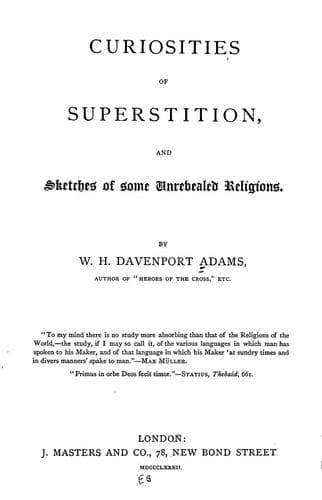
Curiosities of Superstition, and Sketches of Some Unrevealed ReligionsAdams, W. H. Davenport (William Henry Davenport)
Religion
Curiosities of Superstition, and Sketches of Some Unrevealed Religions
Adams, W. H. Davenport (William Henry Davenport)
Folklore; Religions; Superstition
Mr. Deutsch thus seeks to disarm antagonists by a skilful concession. He
does not wonder--not he--that the so-called “Rabbinical stories,”
submitted at intervals to the English public, should have met with an
unflattering reception. The Talmud, which has always at hand a drastic
word, says of their collectors:--“They dived into an ocean, and brought up
a potsherd.” But then, he says, these follies form only a small item in
the vast mass of allegories, parables, and the like, that compose the
Haggadah. And, besides, they are partly ill-chosen, partly ill-translated,
and partly did not even belong to the Talmud, but to some recent Jewish
story books. Herder--to name the most famous critic of the “Poetry of
Peoples”--has spoken most eulogistically of what he saw of the genuine
specimens. And, indeed, “not only is the entire world of pious biblical
legend which Islam has said and sung in its many tongues to the delight of
the wise and simple for twelve centuries, now to be found either in embryo
or fully developed in the Haggadah, but much that is familiar among
ourselves in the circles of mediæval sagas, in Dante, in Boccaccio, in
Cervantes, in Milton, in Bunyan, has consciously or unconsciously flowed
out of this wondrous realm, the Haggadah. That much of it is overstrained,
even according to Eastern notions, we do not deny. But,” argues Mr.
Deutsch, “there are feeble passages even in Homer and Shakespeare.” To
this it may be replied, that in Homer and Shakespeare such passages are
rare, and do not form the bulk of their writings; and, moreover, that for
the Iliad or for Hamlet we do not claim the position of authority which is
claimed for the Talmud.
Let us glance briefly at the cosmogony of the Talmud. It assumes that the
universe has been developed by means of a series of cataclysms; that world
was destroyed after world, until GOD made “this world, and saw that it
was very good.” It assumes also that the kosmos was wrought out of some
original substance, itself created by GOD. “One or three things were
before this world,--Water, Fire, and Wind; Water begat the darkness, Fire
begat light, and Wind begat the spirit of Wisdom.”
Public-domain text, read in full here on John Shaqi.
Reviews
Reviews
No reviews yet
Be the first to share your thoughts on this work.
Elsewhere in the archive
Join the Discussion
Join the discussion
Sign in to leave a comment or review.
Sign InorCreate an account