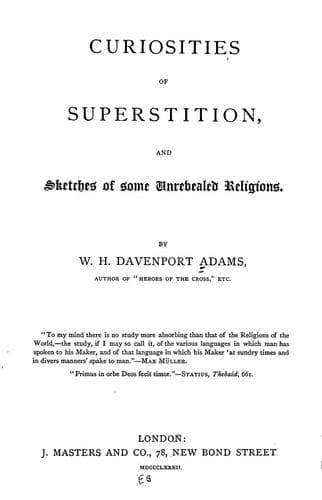
Curiosities of Superstition, and Sketches of Some Unrevealed ReligionsAdams, W. H. Davenport (William Henry Davenport)
Religion
Curiosities of Superstition, and Sketches of Some Unrevealed Religions
Adams, W. H. Davenport (William Henry Davenport)
Folklore; Religions; Superstition
“The _how_ of the creation was not mere matter of speculation. The
co-operation of angels, whose existence was warranted by Scripture, and a
whole hierarchy of whom had been built up under Persian influences, was
distinctly denied. In a discussion about the day of their creation, it is
agreed on all hands that there were no angels at first, lest men might
say, ‘Michael spanned out the firmament on the south, and Gabriel to the
north.’” There is a distinct foreshadowing of the Gnostic Demiurgos--that
antique link between the Divine Spirit and the world of matter--to be
found in the Talmud. What with Plato were the Ideas, with Philo the Logos,
with the Kabbalists the “World of Aziluth,” what the Gnostics called more
emphatically the wisdom (σοφία), or power (δύναμις), and Plotinus the
νοῦς, that the Talmudical authors call Metation. There is a good deal, in
the post-captivity Talmud, about the Angels, borrowed from the Persian.
The Archangels or Angelic princes are seven in number, and their Hebrew
names and functions correspond almost exactly to those of their Persian
prototypes. There are also hosts of ministering angels, the Persian
_Yazatas_, whose functions, besides that of being messengers, were
twofold,--to praise GOD, and to be guardians of man. In their first
capacity they are daily created by GOD’S breath out of a stream of fire
that rolls its waves under the supernal throne. In their second, two of
them accompany every man, and for every new good deed man acquires a new
guardian angel, who always watches over his steps. When a righteous man
dies, three hosts of angels descend from the celestial battlements to meet
him. One says, (in the words of Scripture,) “He shall go in peace;” the
second takes up the strain and says, “Who has walked in righteousness;”
and the third concludes, “Let him come in peace and rest upon his bed.” In
like manner, when the wicked man passes away, three hosts of wicked angels
are ready to escort him, but their address is not couched in any spirit of
consolation or encouragement.
There are various indications in the Talmud of a belief in the
resurrection and immortality of the soul. The resurrection, it teaches, is
to be brought about by the mystic influence of the “Dew of life” in
Jerusalem. It does not uphold the dogma of everlasting damnation, though
it allows that the punishment of apostates, idolaters, and traitors will
endure for “generations upon generations.”
Public-domain text, read in full here on John Shaqi.
Reviews
Reviews
No reviews yet
Be the first to share your thoughts on this work.
Elsewhere in the archive
Join the Discussion
Join the discussion
Sign in to leave a comment or review.
Sign InorCreate an account