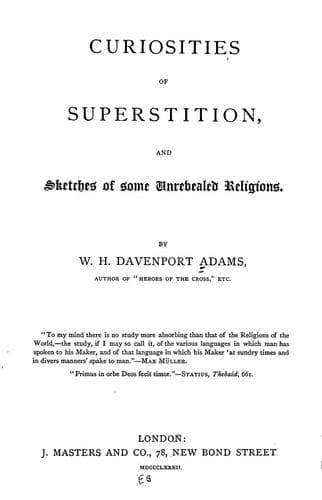
Curiosities of Superstition, and Sketches of Some Unrevealed ReligionsAdams, W. H. Davenport (William Henry Davenport)
Religion
Curiosities of Superstition, and Sketches of Some Unrevealed Religions
Adams, W. H. Davenport (William Henry Davenport)
Folklore; Religions; Superstition
The Vidyadharas and Siddhas, affluent in devotion, waited upon Mahádeva,
the lord of living creatures; and many other beings, of various forms, did
him homage. Prákshasas of terrific semblance, and Pisáchas of great
strength, of different shapes and features, armed with various weapons,
and blazing like fire, were delighted to be present, as the followers of
the god. There stood the royal Naudin, high in the favour of his lord,
armed with a fiery trident, shining with inherent lustre; and there the
best of rivers, Ganga, the assemblage of all holy waters, stood adoring
the mighty deity. Thus worshipped by all the most excellent of sages and
of gods, abode the omnipotent and all-glorious Mahádeva.
In former times Daksha commenced a holy sacrifice on the side of Himavat,
at the sacred spot Gangádwara, frequented by the Rishis. The gods,
desirous of assisting at this solemn rite, came, with Indra at their head,
to Mahádeva, and intimated their purpose, and having received his
permission, departed, in their splendid chariots, to Gangádwara, as
tradition reports. They found Daksha, the best of the devout, surrounded
by the singers and nymphs of heaven, and by numerous sages, beneath the
shade of clustering trees and climbing plants; and all of them, whether
dwellers on earth, in air, or in the regions above the skies, approached
the patriarch with outward gestures of respect. The Adityas, Vasus,
Rudras, Maruts, all entitled to partake of the oblations, together with
Jishnu, were present.
The (four classes of Pitris) Ushmapas, Somapas, Ajyapas, and Dhúmapas, (or
those who feed upon the flame, the acid juice, the butter, or the smoke of
offerings,) the Aswins, and the progenitors, came along with Brahmá.
Creatures of every class, born from the womb, the egg, from vapour, or
vegetation, came upon their invocation; as did all the gods, with their
brides, who, in their resplendent vehicles, blazed like so many fires.
Beholding them thus assembled, the sage Dadhicha was filled with
indignation, and observed: “The man who worships what ought not to be
worshipped, or pays not reverence where veneration is due, is guilty, most
assuredly, of heinous sin.” Then, addressing Daksha, he said to him: “Why
do you not offer homage to the god who is the lord of life (Pasubhartri?)”
Daksha spake: “I have already many Rudras present, armed with tridents,
wearing braided hair, and existing in eleven forms. I recognise no other
Mahádeva.” Dadhicha spake: “The invocation that is not addressed to Isa
is, for all, but a solitary (and imperfect) summons. Inasmuch as I behold
no other divinity who is superior to Sankhara, this sacrifice of Daksha
will not be completed.” Daksha spake: “I offer in a golden cup, this
entire oblation, which has been consecrated by many prayers, as an
offering ever due to the unequalled Vishnu, the sovereign lord of all....”
Public-domain text, read in full here on John Shaqi.
Reviews
Reviews
No reviews yet
Be the first to share your thoughts on this work.
Elsewhere in the archive
Join the Discussion
Join the discussion
Sign in to leave a comment or review.
Sign InorCreate an account