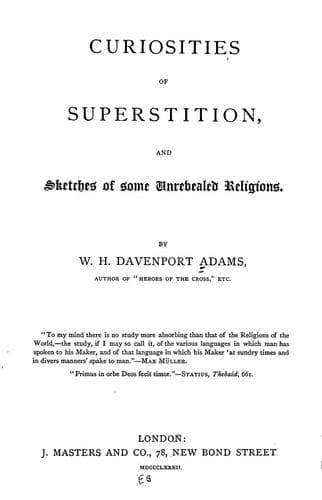
Curiosities of Superstition, and Sketches of Some Unrevealed ReligionsAdams, W. H. Davenport (William Henry Davenport)
Religion
Curiosities of Superstition, and Sketches of Some Unrevealed Religions
Adams, W. H. Davenport (William Henry Davenport)
Folklore; Religions; Superstition
We now proceed to give a few specimens of the contents of this remarkable
work.
_Origin of Rudra_ (Bk. i. c. 8.)
In the beginning of the Kalpa, as Brahma proposed to create a son, who
should be like himself, a youth of a purple complexion appeared; crying
with a low cry, and running about. Brahma, when he beheld him thus
afflicted, said to him: “Why dost thou weep?” “Give me a name,” replied
the boy. “Rudra be thy name,” rejoined the great father of all creatures:
“be composed; desist from tears.” But, though thus addressed, the boy
still wept seven times; and Brahma therefore gave to him seven other
denominations: and to these eight persons regions and wives and posterity
belong. The eight manifestations, then, are named Rudra, Bhava, Sarva,
Isana, Pasaputi, Bhima, Ugra, and Mahádeva, which were given to them by
their great progenitor. He also assigned to them their respective
stations, the sun, water, earth, air, fire, ether, the ministrant Brahman,
and the moon; for these are their several forms. The wives of the sun and
the other manifestations, termed Rudra and the east, were, respectively:
Suvarchalá, Ushá, Vikésí, Sívá, Swáhá, Disas, Dikshá, and Rohini. Now hear
an account of their progeny, by whose successive generations this world
has been peopled. Their sons were severally: Sawaischara (Saturn,) Sukra
(Venus,) the fiery-bodied (Mars,) Mamjava, Skanda, Swarga, Santána, and
Budha (Mercury.)
_Sacrifice of Daksha._
(This remarkable legend, according to Professor Wilson, is intended to
allegorise a struggle between the worshippers of Siva and of Vishnu, in
which the former, after a temporary defeat, obtained the victory.)
There was formerly a peak of Meru, named Sávitra, abounding with gems,
radiant as the sun, and celebrated throughout the three worlds; of immense
extent, difficult of access, and an object of universal adoration. Upon
that glorious eminence, rich with mineral treasures, as upon a splendid
couch, the deity Siva reclined, accompanied by the daughter of the
sovereign of mountains, and attended by the mighty Adityas, the powerful
Vasus, and by the heavenly physicians, the sons of Aswini; by Kubera,
surrounded by his train of Guhyakas, the lord of the Yakshas, who dwells
on Kailása. There also was the great Muni Usanas: there were Rishis of the
first order, with Sanatkumará at their head, divine Rishis, preceded by
Angiras; Viswavasu, with his bands of heavenly choristers; the sages
Nárada and Parvata; and innumerable troops of celestial nymphs.
The breeze blew upon the mountain, bland, pure, and fragrant; and the
trees were decorated with flowers that blossomed in every season.
Public-domain text, read in full here on John Shaqi.
Reviews
Reviews
No reviews yet
Be the first to share your thoughts on this work.
Elsewhere in the archive
Join the Discussion
Join the discussion
Sign in to leave a comment or review.
Sign InorCreate an account