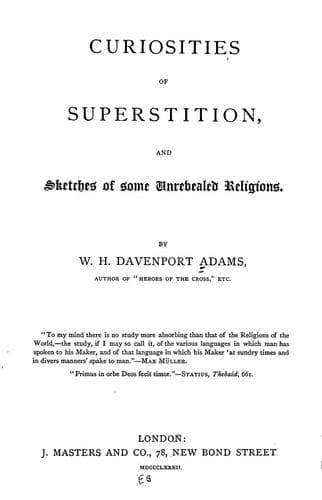
Curiosities of Superstition, and Sketches of Some Unrevealed ReligionsAdams, W. H. Davenport (William Henry Davenport)
Religion
Curiosities of Superstition, and Sketches of Some Unrevealed Religions
Adams, W. H. Davenport (William Henry Davenport)
Folklore; Religions; Superstition
The sage, or Yogin, when first applying himself to contemplative devotion,
is called the novice or practitioner (Yoga-yuj); when he has attained
spiritual union, he is termed the adept, or he whose meditations are
accomplished. Should the thoughts of the former be unvitiated by any
obstructing imperfection, he will obtain freedom, after practising
devotion through several lives. The latter speedily obtains liberation in
that existence in which he reaches perfection, all his acts being consumed
by the fire of contemplative devotion. The sage who would bring his mind
into a fit state for the performance of devout contemplation must be
devoid of desire, and observe invariably continence, compassion, truth,
honesty, and disinterestedness: he must fix his mind intently on the
supreme Brahma, practising holy study, purification, contentment, penance,
and self-control. These virtues, respectively termed the five acts of
restraint (Yama) and five of obligation (Niyama), bestow excellent
rewards, when practised for the sake of reward, and eternal liberation,
when they are not prompted by desire of transient benefits. Endowed with
these merits, the sage, self-restrained, should sit in one of the modes
termed Bhadrasana,[28] and engage in contemplation.
Bringing his vital airs, called Prana, under subjection, by frequent
repetition, is thence called a Pranayama, which is, as it were, a seed
with a seed. In this, the breath of expiration and that of inspiration are
alternately obstructed, constituting the act twofold; and the suppression
of both modes of breathing produces a third. The exercise of the Yogin,
whilst endeavouring to bring before his thoughts the gross form of the
Eternal, is denominated Alambana.[29] He is then to perform the
Pratyahara, which consists in restraining his organs of sense from
susceptibility to outward impressions, and directing them entirely to
mental perceptions. By these means the entire subjugation of the unsteady
senses is effected; and, if they are not controlled, the sage will not
accomplish his devotions. When, by the Pranayama, the vital airs are
restrained, and the senses are subjugated by the Pratyahara, then indeed
the sage will be able to keep his mind steady in its perfect asylum.
The sage now plunges into transcendentalism which would be barely
intelligible, and certainly uninteresting to the reader, and we shall
therefore decline to follow him, concluding our extract with the
description of Vishnu which Kesidhwaja furnishes to his inquiring guest.
Public-domain text, read in full here on John Shaqi.
Reviews
Reviews
No reviews yet
Be the first to share your thoughts on this work.
Elsewhere in the archive
Join the Discussion
Join the discussion
Sign in to leave a comment or review.
Sign InorCreate an account