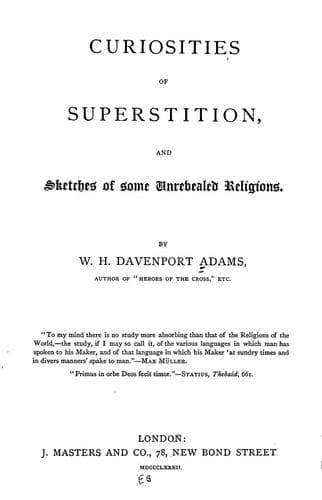
Curiosities of Superstition, and Sketches of Some Unrevealed ReligionsAdams, W. H. Davenport (William Henry Davenport)
Religion
Curiosities of Superstition, and Sketches of Some Unrevealed Religions
Adams, W. H. Davenport (William Henry Davenport)
Folklore; Religions; Superstition
Think of him as having a pleased and lovely countenance, with eyes like
the leaf of the lotus, marble cheeks, and a broad and brilliant forehead;
ears of equal size, the lobes of which are decorated with splendid
pendants; a painted neck; and a broad breast, on which shines the Srivatsa
mark; a belly falling in graceful folds, with a deep-seated navel; eight
long arms, or else four; and firm and well-knit thighs and legs, with
well-formed feet and toes. Let him, with well-governed thoughts,
contemplate, as long as he can persevere in unremitting attention, Hari,
as clad in a yellow robe, wearing a rich diadem on his head, and brilliant
armlets and bracelets on his arms, and bearing in his hands the bow, the
shell, the mace, the sword, the discus, the rosary, the lotus, and the
arrow.
CHAPTER VI.
_IN CHINA:--CONFUCIANISM, TAOUISM, AND BUDDHISM._
The creeds in vogue amongst the Chinese may be regarded as
three:--_Confucianism_, the religion of the state; _Taouism_, the religion
of the philosophers; and _Buddhism_, the religion of the people.
It has been justly said that a religion which, like Confucianism, has
exercised for twenty-four centuries a potent influence over the Chinese
mind, though owing its name and origin to a simple citizen, must possess
in it something well worthy of consideration. There must be in it a spell
which strongly attracts the popular sympathies. This spell is said to be,
though possibly we ought to search deeper and farther for it, the purely
practical character of its tenets, and the harmony which exists between
those tenets and the patriarchal character of the government and the
institutions of the country. And in fact it is not so much a religion as
an ethical system,--something such as Christianity would be, if we took
out of it JESUS CHRIST. Or we may distinguish it as “a system of
ceremonies on a moral basis,” and, as such, admirably adapted to the
tastes and needs of so ceremonial-loving a people as the Chinese. To this
day the Ly-pou watch with jealous vigilance the maintenance of all the old
traditional rites, and rigidly enforce the observance of the traditional
details in the construction of the temples. Moreover such particulars as
the six kinds of sceptres, the five kinds of mats, and the five kinds of
stools are strictly insisted upon; and it is known that the innumerable
prescribed sacrifices offered to the various gods of the heaven and the
earth, to a man’s forefathers, to the hills and the rivers, the sea and
the central mount, the god of the south pole and the god of thunder, are
the same now as they have been for upwards of 2,000 years.
The founder of Confucianism, Kong-foo-tse, or Confucius, (as the Jesuits
latinised the name,) was born about 550 B.C. in the state Loo, within the
district now called Keo-fou Hien, lying to the eastward of the great
Imperial canal, in the province of Shang-tung.
Public-domain text, read in full here on John Shaqi.
Reviews
Reviews
No reviews yet
Be the first to share your thoughts on this work.
Elsewhere in the archive
Join the Discussion
Join the discussion
Sign in to leave a comment or review.
Sign InorCreate an account