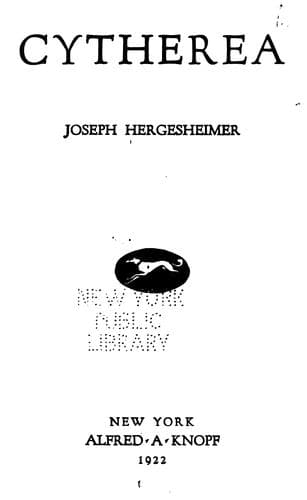
Adultery -- Fiction; Cuba -- Fiction; Runaway husbands -- Fiction
When they couldn't get there they crowded into their borough towns, into
Eastlake, at every opportunity, attracted by the gaiety, the lights, the
stir, the contact with humanity. Before prohibition they had drunk at
the hotel bars, and driven home, with discordant laughter and the urged
clatter of hoofs, to the silence of star-lit fields. The buggies had
gone; High Street, on Saturday night, was filled with automobiles;
there was practically no drunkenness; but there was no lessening in the
restless seeking stream of men, the curiosity of the women with folded
hands and tightly folded lips.
They all wanted a mitigation of a life which, fundamentally, did not
fill them; they had an absorbing labor, love and home and children,
the church, yet they were unsatisfied. They were discontented with
the primary facts of existence, the serious phases, and wanted, above
everything, tinsel and laughter. If a girl passing on the street smiled
boldly at such youths they were fired with triumph and happiness; they
nudged each other violently and made brazen declarations which, faced by
the girls, escaped in disconcerted laughter. Their language--and this,
too, was a revolt--was like the sweepings of the cow barns.
Life, it occurred to Lee Randon, in this connection, was amazingly
muddled; and he wondered what would happen if the restraint, since it
was no better than sham, should be swept away, and men acknowledged what
they so largely were? A fresh standard, a new set of values, would have
to be established. But before that could be accomplished an underlying
motive must be discovered. That he searched for in himself; suppose he
were absolutely free, not tomorrow, that evening, but now--
Would he go to the office, to the affairs of the Zenith cigarette, and,
once there, would he come home again--the four thirty-seven train and
the Ford in the shed by the station? Lee couldn't answer this finally. A
road led over the hills on the right, beyond a horizon of trees. He knew
it for only a short distance; where ultimately it led he had no idea.
But it was an enticing way, and he had an idiotic impulse to turn aside,
follow it, and never come back any more. Actually he almost cut in, and
he had to swing the car sharply to the left.
If he had been in trouble or debt, if his life had been a failure, he
would have understood his impulse; but as it was, with Fanny and Helena
and Gregory, all his flourishing affairs--why, it was insanity! However,
what absorbed him in his present state of mind, of inquiry, was its
honesty; nothing could be served by conventional protests and
nice sentiments. Lee had long wanted to escape from life, from the
accumulating limiting circumstances. Or was it death he tried to avoid?
Public-domain text, read in full here on John Shaqi.
Reviews
Reviews
No reviews yet
Be the first to share your thoughts on this work.
Join the Discussion
Join the discussion
Sign in to leave a comment or review.
Sign InorCreate an account