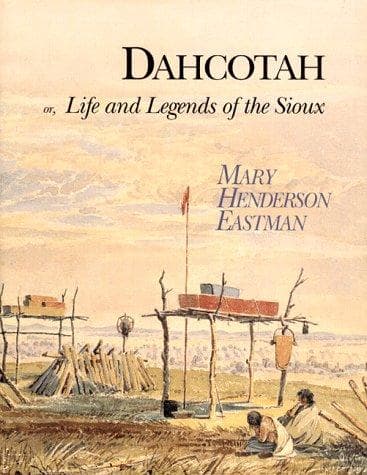
Dahcotah: Life and Legends of the Sioux Around Fort SnellingEastman, Mary H. (Mary Henderson)
History
Dahcotah: Life and Legends of the Sioux Around Fort Snelling
Eastman, Mary H. (Mary Henderson)
Dakota Indians -- Folklore; Dakota Indians -- History; Dakota Indians -- Social life and customs
The two boys represent war: they are painted red, and hold war-clubs in
their hands. The girls have their faces painted with blue clay: they
represent peace.
On one side of the circle a kind of booth is erected, and about twenty
feet from it a wigwam. There are four entrances to this circle.
When all the arrangements for the dance are concluded, the man who
gives the dance emerges from his wigwam dressed up as hideously as
possible, crawling on all fours towards the booth. He must sing four
tunes before reaching it.
In the meantime the medicine men, who are seated in the wigwam, beat
time on the drum, and the young men and squaws keep time to the music by
first hopping on one foot, and then on the other--moving around inside
the ring as fast as they can. This is continued for about five minutes,
until the music stops. After resting a few moments, the second tune
commences, and lasts the same length of time, then the third, and the
fourth; the Indian meanwhile making his way towards the booth. At the
end of each tune, a whoop is raised by the men dancers.
After the Indian has reached his booth inside the ring, he must sing
four more tunes as before. At the end of the fourth tune the squaws all
run out of the ring as fast as possible, and must leave by the same way
that they entered, the other three entrances being reserved for the men,
who, carrying their war implements, might be accidentally touched by one
of the squaws--and the war implements of the Sioux warrior have from
time immemorial been held sacred from the touch of woman. For the same
reason the men form the inner ring in dancing round the pole, their war
implements being placed at the foot of the pole.
When the last tune is ended, the young men shoot at the image of thunder
which is hanging to the pole, and when it falls a general rush is made
by the warriors to get hold of it. There is placed at the foot of the
pole a bowl of water colored with blue clay. While the men are trying
to seize the parts of the bark representation of their god, they at the
same time are eagerly endeavoring to drink the water in the bowl, every
drop of which must be drank.
The warriors then seize on the two boys and girls--the representations
of war and peace--and use them as roughly as possible--taking their
pipes and war-clubs from them, and rolling them in the dirt until the
paint is entirely rubbed off from their faces. Much as they dislike this
part of the dance, they submit to it through fear, believing that after
this performance the power of thunder is destroyed.
Now that the water is drank up and the guardians of the Thunder bird are
deprived of their war-clubs and pipes, a terrible wailing commences. No
description could convey an idea of the noise made by their crying and
lamentation. All join in, exerting to the utmost the strength of
their lungs.
Public-domain text, read in full here on John Shaqi.
Reviews
Reviews
No reviews yet
Be the first to share your thoughts on this work.
Elsewhere in the archive
Join the Discussion
Join the discussion
Sign in to leave a comment or review.
Sign InorCreate an account