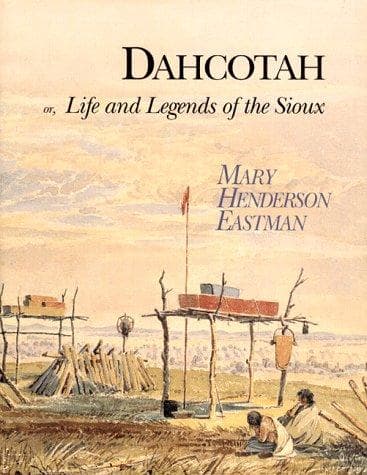
Dahcotah: Life and Legends of the Sioux Around Fort SnellingEastman, Mary H. (Mary Henderson)
History
Dahcotah: Life and Legends of the Sioux Around Fort Snelling
Eastman, Mary H. (Mary Henderson)
Dakota Indians -- Folklore; Dakota Indians -- History; Dakota Indians -- Social life and customs
Before the men shoot at thunder, the squaws must leave the ring. No one
sings at this dance but the warrior who gives it; and while the
visitors, the dancers, and the medicine men, women and children, all are
arrayed in their gayest clothing, the host must be dressed in
his meanest.
In the dance Ahahkah Koyah, or to make the Elk a figure of thunder, is
also made and fought against. The Sioux have a great deference for the
majesty of thunder, and, consequently for their own skill in prevailing
or seeming to prevail against it.
A Sioux is always alarmed after dreaming of an elk, and soon prevails
upon some of his friends to assist him in dancing, to prevent any evil
consequences resulting from his dream. Those willing to join in must lay
aside all clothing, painting their bodies with a reddish gray color,
like the elk's. Each Indian must procure two long saplings, leaving the
boughs upon them. These are to aid the Indians in running. The saplings
must be about twelve feet in length. With them they tear down the bark
image of thunder, which is hung with a string to the top of the pole.
All being ready, the elks run off at a gallop, assisted by their
saplings, to within about two hundred yards of the pole, when they stop
for a while, and then start again for the pole, to which is attached the
figure of thunder.
They continue running round and round this pole, constantly striking the
figure of thunder with their saplings, endeavoring to knock it down,
which after a while they succeed in accomplishing.
The ceremony is now ended, and the dreamer has nothing to fear from elks
until he dreams again.
There is no end to the superstitions and fancies entertained by the
Sioux concerning thunder. On the cradle of the Indian child we
frequently see the figure of thunder represented. It is generally carved
on the wood by the father of the child, with representations of the Elk,
accompanied with hieroglyphic looking figures, but thunder is regarded
as the type of all animals that fly.
Public-domain text, read in full here on John Shaqi.
Reviews
Reviews
No reviews yet
Be the first to share your thoughts on this work.
Elsewhere in the archive
Join the Discussion
Join the discussion
Sign in to leave a comment or review.
Sign InorCreate an account