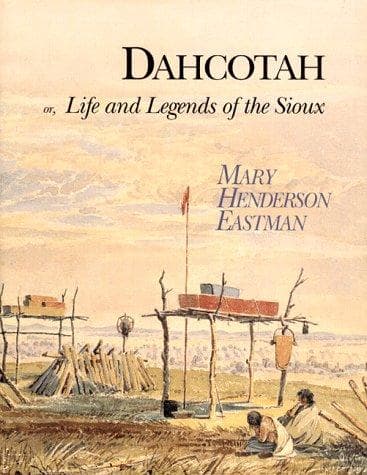
Dahcotah: Life and Legends of the Sioux Around Fort SnellingEastman, Mary H. (Mary Henderson)
History
Dahcotah: Life and Legends of the Sioux Around Fort Snelling
Eastman, Mary H. (Mary Henderson)
Dakota Indians -- Folklore; Dakota Indians -- History; Dakota Indians -- Social life and customs
We can see they are passing away, but who can decide the interesting
question of their origin? They told me that their nation had always
lived in the valley of the Mississippi--that their wise men had asserted
this for ages past. Some who have lived among them, think they crossed
over from Persia in ships--and that they once possessed the knowledge of
building large vessels, though they have now entirely lost it. This idea
bears too little probability to command any confidence. The most general
opinion is the often told one, that they are a remnant of God's ancient
and chosen people. Be this as it may, they are "as the setting sun, or
as the autumn leaves trampled upon by powerful riders."
They are receding rapidly, and with feeble resistance, before the giant
strides of civilization. The hunting grounds of a few savages will soon
become the haunts of densely peopled, civilized settlements. We should
be better reconciled to this manifest destiny of the aborigines, if the
inroads of civilization were worthy of it; if the last years of these,
in some respects, noble people, were lit up with the hope-inspiring rays
of Christianity. We are not to judge the Heathen; yet universal evidence
gives the melancholy fact, that the light of nature does not lead the
soul to God: and without judging of their destiny, we are bound to
enlighten their minds. We know the great Being of whom they are
ignorant; and well will it be for them and for us, in a day that awaits
us all, if yet, though late, sadly late--yet not too late, we so give
countenance and aid to the missionary, that the light of revealed truth
may cheer the remaining period of their national and individual,
existence.
Will it be said that I am regarding, with partial eye and sentimental
romance, but one side of the Sioux character? Have they no faults, as a
people and individually? They are savages--and that goes far to answer
the question. Perhaps the best answer is, the women have faults enough,
and the men twice as many as the women. But if to be a savage is to be
cruel, vindictive, ferocious--dare we say that to be a civilized man
necessarily implies freedom from these traits?
Want of truth, and habitual dishonesty in little things, are prevalent
traits among the Sioux. Most of them will take a kitchen spoon or fork,
if they have a chance--and they think it fair thus to return the
peculations of the whites. They probably have an idea of making up for
the low price at which their lands have been valued, by maintaining a
constant system of petty thefts--or perhaps they consider kitchen
utensils as curiosities, just as the whites do their mocassins and
necklaces of bear's claws. Yes--it must be confessed, however
unsentimental, they almost all steal.
Public-domain text, read in full here on John Shaqi.
Reviews
Reviews
No reviews yet
Be the first to share your thoughts on this work.
Join the Discussion
Join the discussion
Sign in to leave a comment or review.
Sign InorCreate an account