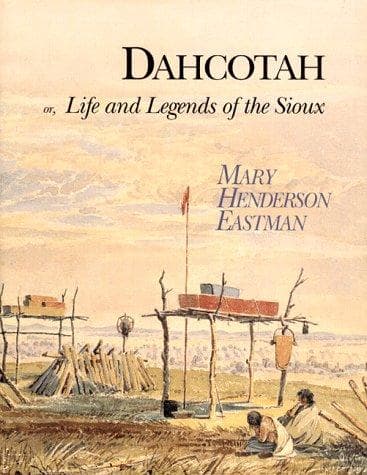
Dahcotah: Life and Legends of the Sioux Around Fort SnellingEastman, Mary H. (Mary Henderson)
History
Dahcotah: Life and Legends of the Sioux Around Fort Snelling
Eastman, Mary H. (Mary Henderson)
Dakota Indians -- Folklore; Dakota Indians -- History; Dakota Indians -- Social life and customs
These are some of the customs of the Dahcotahs, which, however absurd
they may appear to us, are held in sacred reverence by them. There are
some animals, birds and fishes, that an Indian venerates; and the
creature thus sacred, he dare neither kill nor eat. The selection is
usually a bear, buffalo, deer, otter, eagle, hawk or snake. One will not
eat the right wing of a bird; another dare not eat the left: nor are the
women allowed to eat any part that is considered sacred.
The Sioux say it is lawful to take revenge, but otherwise it is not
right to murder. When murder is committed, it is an injury to the
deceased; not a sin against the Great Spirit. Some of their wise men say
that the Great Spirit has nothing to do with their affairs, present or
future. They pretend to know but little of a future state. They have
dreamy ideas of large cities somewhere in the heavens, where they will
go, but still be at war with their enemies and have plenty of game. An
Indian woman's idea of future happiness consists in relief from care.
"Oh! that I were dead," they will often say, "when I shall have no more
trouble." Veneration is much regarded in all Indian families. Thus a
son-in-law must never call his father-in-law by his name, but by the
title father-in-law, and vice versa. A female is not permitted to handle
the sac for war purposes; neither does she dare look into a
looking-glass, for fear of losing her eyesight.
The appearance of a brilliant aurora-borealis occasions great alarm. The
Indians run immediately for their guns and bows and arrows to shoot at
it, and thus disperse it.
III.
INDIAN NAMES AND WRITING.
The names of the Sioux bands or villages, are as fanciful as those given
to individuals. Near Fort Snelling, are the "Men-da-wahcan-tons," or
people of the spirit lakes; the "Wahk-patons," or people of the leaves;
the "Wahk-pa-coo-tahs," or people that shoot at leaves, and other bands
who have names of this kind. Among those chiefs who have been well-known
around Fort Snelling, are,
Wah-ba-shaw, The Leaf.
Wah-ke-on-tun-kah, Big Thunder.
Wah-coo-ta, Red Wing.
Muzza Hotah, Gray Iron.
Ma-pe-ah-we-chas-tah, The man in the Cloud.
Tah-chun-coo-wash-ta, Good Road.
Sha-ce-pee, The Sixth.
Wah-soo-we-chasta-ne, Bad Hail.
Ish-ta-hum-bah, Sleepy Eyes.
These fanciful names are given to them from some peculiarity in
appearance or conduct; or sometimes from an occurrence that took place
at the time that they usually receive the name that is ascribed to them
for life. There is a Sioux living in the neighborhood of Fort Snelling,
called "The man that walks with the women." It is not customary for the
Indian to show much consideration for the fair sex, and this young man,
exhibiting some symptoms of gallantry unusual among them, received the
above name.
The Sioux have ten names for their children, given according to the
order of their birth.
Public-domain text, read in full here on John Shaqi.
Reviews
Reviews
No reviews yet
Be the first to share your thoughts on this work.
Join the Discussion
Join the discussion
Sign in to leave a comment or review.
Sign InorCreate an account