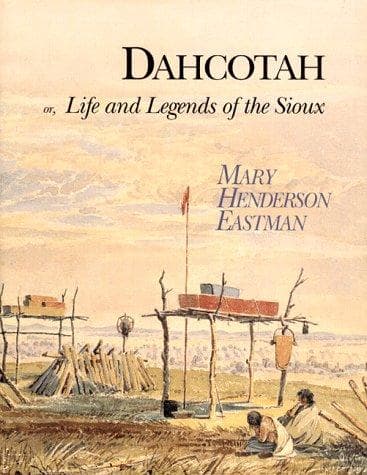
Dahcotah: Life and Legends of the Sioux Around Fort SnellingEastman, Mary H. (Mary Henderson)
History
Dahcotah: Life and Legends of the Sioux Around Fort Snelling
Eastman, Mary H. (Mary Henderson)
Dakota Indians -- Folklore; Dakota Indians -- History; Dakota Indians -- Social life and customs
One of the chiefs, "Sleepy Eyes," visited a missionary not many weeks
since, and on being asked why he did not come at the time appointed,
replied, "How could I come when I have no mocassins," meaning that he
had no horse. The horse had recently been killed by a man who owed him
a grudge; and his way of alluding to the loss was the mocassins. On
another occasion, this same chief, having done what he considered a
favor for the missionaries, at _Traverse des Sioux_, told them that his
coat was worn out, and that he had neither cloth nor thread to mend it;
the fact was, that he had no coat at all, no cloth nor thread; his
brawny neck and arms were entirely bare, and this was his way of begging
for a new coat.
In Indian warfare, the victor takes the scalp of his enemy. If he have
time, he takes the entire scalp, including the ears; but if hurried, a
smaller scalp-piece is taken. As an inducement to be foremost in battle,
the first four that touch the dead body of an enemy, share the honors
that are paid to the one who slew the foe and took the scalp. But the
victors in Indian fight frequently suffer in this way; a wounded savage
feigns death, and, as some warrior approaches to take his scalp, he will
suddenly rise, discharge his gun, and fight desperately with the
tomahawk until killed. Deeds of valor performed by Indians are as often
done from desperation as from any natural bravery. They are educated to
warfare, but often show great disinclination to fight; strategy goes
farther with them than manly courage does. At Fort Snelling, the Sioux
have more than once crouched under the walls of the fort for protection,
and on one occasion a chief, who came in to give information of the
approach of some Chippeways trembled so as to shake the ornaments about
his dress.
INDIAN WRITING.
[Illustration: No. I and 3, prisoners captured by No. 2. (No hands on
the prisoners.) No. 1, female prisoner. No. 3, male.]
[Illustration: Nos. 4 and 5, female and male killed; 6 and 7, boy and
girl killed.]
[Illustration: No. 8, that he has killed his enemy; 9, that he has cut
the throat of his enemy, and taken the scalp; 10, that he was the third
that touched the body of his enemy after he was killed; 11, the fourth
that touched it; 12, the fifth that touched it.]
[Illustration: No. 13, been wounded in many places by this enemy; 15,
that he has cut the throat of the enemy.]
The above represents the feathers from the war eagle. They are worn in
the hair of the warriors, as honors.
The above represents the only way that the Sioux have of writing an
account of an engagement that has taken place.
IV.
INDIAN CHILDREN.
Public-domain text, read in full here on John Shaqi.
Reviews
Reviews
No reviews yet
Be the first to share your thoughts on this work.
Join the Discussion
Join the discussion
Sign in to leave a comment or review.
Sign InorCreate an account