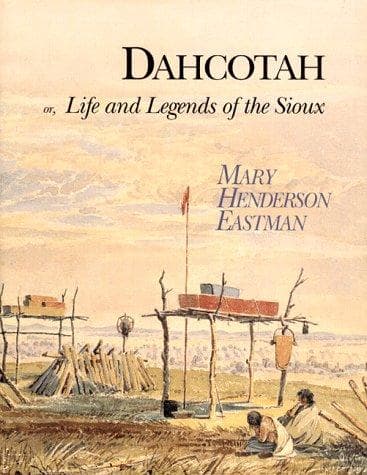
Dahcotah: Life and Legends of the Sioux Around Fort SnellingEastman, Mary H. (Mary Henderson)
History
Dahcotah: Life and Legends of the Sioux Around Fort Snelling
Eastman, Mary H. (Mary Henderson)
Dakota Indians -- Folklore; Dakota Indians -- History; Dakota Indians -- Social life and customs
Red Earth witnessed the cutting down of the old woman, and as she
returned to her teepee, her quick ear warned her of coming footsteps.
She lingered apart from the others, and soon she saw the eagle feathers
of her warrior as he descended the hill towards the village. Gladly
would she have gone to meet him to welcome him home, but she knew that
Shining Iron was watching her motions, and she bent her steps homeward.
She was quite sure that it would not be long before he would seek her,
and then she would tell him what had passed, and make arrangements for
their course of conduct for the future.
Fiery Wind was the nephew of Good Road, but he, like the sons, was in
disgrace with the chief, and, like them, he had vowed vengeance against
"Old Bets."
CHAPTER III.
The gun is now generally used among the Dahcotahs as a weapon of
warfare. But those bands in the neighborhood of Fort Snelling considered
it as a necessary part of their war implements, before the distant bands
were at all acquainted with its use.
Some time ago, one of the Mun-da-wa-kan-tons gave a gun to a Sisse-ton,
who, proud of the gift, went out immediately to use it. On his return to
his village he came up with a drove of buffaloes. His first impulse was
to use his bow and arrow, but a moment's thought reminded him of the
gift of his friend. He loaded the gun, saying at the same time to it,
"Now, the Dahcotahs call you 'wah-kun' (supernatural), kill me the
fattest cow in the drove." He waited a few moments to see his orders
executed, but the gun was not "wah-kun" enough to fire by order alone.
Seeing that it did not go off, the Sisse-ton flew into a rage and broke
the gun into pieces. "I suppose," said he "that if a Mun-da-wah-can-ton
had told you to kill a buffalo, you would have done it, but you do not
regard what a Sisse-ton says." So he threw the pieces of the gun away,
and found his bow and arrows of far more service.
However naturally the usages of warfare may come to the Indians, they
are also made a part of their education.
The children are taught that it is wicked to murder without a cause;
but when offence has been given, they are in duty bound to retaliate.
Public-domain text, read in full here on John Shaqi.
Reviews
Reviews
No reviews yet
Be the first to share your thoughts on this work.
Join the Discussion
Join the discussion
Sign in to leave a comment or review.
Sign InorCreate an account