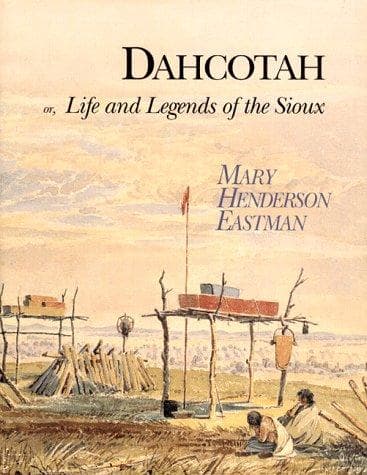
Dahcotah: Life and Legends of the Sioux Around Fort SnellingEastman, Mary H. (Mary Henderson)
History
Dahcotah: Life and Legends of the Sioux Around Fort Snelling
Eastman, Mary H. (Mary Henderson)
Dakota Indians -- Folklore; Dakota Indians -- History; Dakota Indians -- Social life and customs
After a while, the wolf is seen emerging from his retreat, painted so
hideously as to frighten away the Indian children. The cormorants
perceive the approach of the wolf, and a general quacking and flapping
takes place, each one rushing to his nest to secure his food.
This food each cormorant seizes and tries to swallow, flapping his wings
and stretching out his neck as a young bird will when fed by its mother.
After the most strenuous exertions they succeed in swallowing the raw
fish. While this is going on, the wolf seizes the opportunity to make a
snap at the remainder of the fish, seizes it with his teeth, and makes
his way out of the ring, as fast as he can, on all fours. The whole of
the fish, bones and all, must be swallowed; not the smallest portion of
it can be left, and the fish must only be touched by the mouth--never
with the hands. This dance is performed by the men alone--their war
implements must be sacred from the touch of women.
Such scenes are witnessed every day at the Dahcotah villages. The
missionary sighs as he sees how determined is their belief in such a
religion. Is it not a source of rejoicing to be the means of turning one
fellow-creature from a faith like this?
A few years ago and every Dahcotah woman reverenced the fish-dance as
holy and sacred--even too sacred for her to take a part in it. She
believed the medicine women could foretell future events; and, with an
injustice hardly to be accounted for, she would tell you it was lawful
to beat a girl as much as you chose, but a sin to strike a boy!
She gloried in dancing the scalp dance--aye, even exulted at the idea of
taking the life of an enemy herself.
But there are instances in which these things are all laid aside beneath
the light of Christianity; instances in which the poor Dahcotah woman
sees the folly, the wickedness of her former faith; blesses God who
inclined the missionary to leave his home and take up his abode in the
country of the savage; and sings to the praise of God in her own tongue
as she sits by the door of her wigwam. She smiles as she tells you that
her "face is dark, but that she hopes her heart has been changed; and
that she will one day sing in heaven, where the voices of the white
people and of the converted Dahcotahs, will mingle in a song of love to
Him 'who died for the whole world.'"
WABASHAW.
CHAPTER I.
Wabashaw, (or The Leaf,) is the name of one of the Dahcotah Chiefs. His
village is on the Mississippi river, 1,800 miles from its mouth.
The teepees are pitched quite near the shore, and the many bluffs that
rise behind them seem to be their perpetual guards.
The present chief is about thirty-five years old--as yet he has done not
much to give him a reputation above the Dahcotahs about him. But his
father was a man whose life and character were such as to influence his
people to a great degree.
Public-domain text, read in full here on John Shaqi.
Reviews
Reviews
No reviews yet
Be the first to share your thoughts on this work.
Elsewhere in the archive
Join the Discussion
Join the discussion
Sign in to leave a comment or review.
Sign InorCreate an account