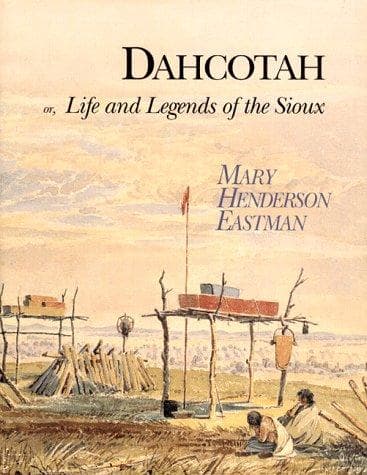
Dahcotah: Life and Legends of the Sioux Around Fort SnellingEastman, Mary H. (Mary Henderson)
History
Dahcotah: Life and Legends of the Sioux Around Fort Snelling
Eastman, Mary H. (Mary Henderson)
Dakota Indians -- Folklore; Dakota Indians -- History; Dakota Indians -- Social life and customs
Wabashaw the elder, (for the son inherits his father's name,) is said by
the Dahcotahs to have been the first chief in their tribe.
Many years ago the English claimed authority over the Dahcotahs, and an
English traveller having been murdered by some Dahcotahs of the band of
which Wabashaw was a warrior, the English claimed hostages to be given
up until the murderer could be found.
The affairs of the nation were settled then by men who, having more mind
than the others, naturally influenced their inferiors. Their bravest
men, their war chief too, no doubt exercised a control over the rest.
Wabashaw was one of the hostages given up in consequence of the murder,
and the Governor of Canada required that these Dahcotahs should leave
the forests of the west, and remain for a time as prisoners in Canada.
Little as is the regard for the feelings of the savage now, there was
still less then.
Wabashaw often spoke of the ill treatment he received on his journey. It
was bad enough to be a prisoner, and to be leaving home; it was far
worse to be struck, for the amusement of idle men and children--to have
the war eagle's feather rudely torn from his head to be trampled
upon--to have the ornaments, even the pipes of the nation, taken away,
and destroyed before his eyes.
But such insults often occurred during their journey, and the prisoners
were even fettered when at last they reached Quebec.
Here for a long time they sighed to breathe the invigorating air of the
prairies; to chase the buffalo; to celebrate the war dance. But when
should they join again in the ceremonies of their tribe? When? Alas!
they could not even ask their jailer when; or if they had, he would only
have laughed at the strange dialect that he could not comprehend. But
the Dahcotahs bore with patience their unmerited confinement, and
Wabashaw excelled them all. His eye was not as bright as when he left
home, and there was an unusual weakness in his limbs--but never should
his enemies know that he suffered. And when those high in authority
visited the prisoners, the haughty dignity of Wabashaw made them feel
that the Dahcotah warrior was a man to be respected.
But freedom came at last. The murderers were given up; and an
interpreter in the prison told Wabashaw that he was no longer a
prisoner; that he would soon again see the Father of many waters; and
that more, he had been made by the English a chief, the first chief of
the Dahcotahs.
It was well nigh too late for Wabashaw. His limbs were thin, and his
strength had failed for want of the fresh air of his native hills.
Little did the prisoners care to look around as they retraced their
steps. They knew they were going home. But when the waters of the
Mississippi again shone before them, when the well-known bluffs met
their eager gaze; when the bending river gave to view their native
village, then, indeed, did the new-made chief cast around him the "quiet
of a loving eye." Then, too, did he realize what he had suffered.
Public-domain text, read in full here on John Shaqi.
Reviews
Reviews
No reviews yet
Be the first to share your thoughts on this work.
Elsewhere in the archive
Join the Discussion
Join the discussion
Sign in to leave a comment or review.
Sign InorCreate an account