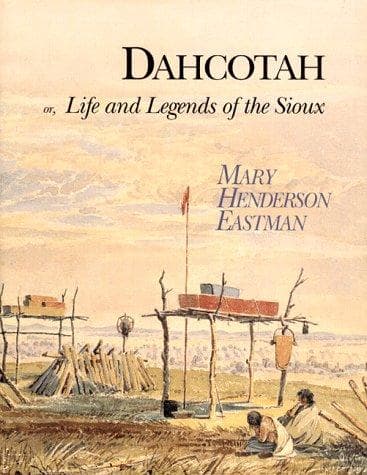
Dahcotah: Life and Legends of the Sioux Around Fort SnellingEastman, Mary H. (Mary Henderson)
History
Dahcotah: Life and Legends of the Sioux Around Fort Snelling
Eastman, Mary H. (Mary Henderson)
Dakota Indians -- Folklore; Dakota Indians -- History; Dakota Indians -- Social life and customs
He strained his sight--for perhaps his wife might have wearied of
waiting for him--perhaps she had gone to the Land of spirits, hoping to
meet him there.
His children too--the young warriors, who were wont to follow him and
listen to his voice, would they welcome him home?
As he approached the village a cloud had come between him and the sun.
He could see many upon the shore, but who were they? The canoe swept
over the waters, keeping time to the thoughts of those who were
wanderers no longer.
As they neared the shore, the cloud passed away and the brightness of
the setting sun revealed the faces of their friends; their cries of joy
rent the air--to the husband, the son, the brother, they spoke a
welcome home!
Wabashaw, by the command of the English Governor, was acknowledged by
the Dahcotahs their first chief; and his influence was unbounded. Every
band has a chief, and the honor descends from father to son; but there
has never been one more honored and respected than Wabashaw.
CHAPTER II.
Wabashaw's village is sometimes called Keusca. This word signifies to
break through, or set aside; it was given in consequence of an incident
which occurred some time ago, in the village.
"Sacred Wind" was a daughter of one of the most powerful families among
the Dahcotahs; for although a chief lives as the meanest of his band,
still there is a great difference among the families. The number of a
family constitutes its importance; where a family is small, a member of
it can be injured with little fear of retaliation; but in a large family
there are sure to be found some who will not let an insult pass without
revenge. Sacred Wind's father was living; a stalwart old warrior,
slightly bent with the weight of years. Though his face was literally
seamed with wrinkles, he could endure fatigue, or face danger, with the
youngest and hardiest of the band.
Her mother, a fearfully ugly old creature, still mended mocassins and
scolded; bidding fair to keep up both trades for years to come. Then
there were tall brothers, braving hardships and danger, as if a Dahcotah
was only born to be scalped, or to scalp; uncles, cousins, too, there
were, in abundance, so that Sacred Wind did belong to a powerful family.
Now, among the Dahcotahs, a cousin is looked upon as a brother; a girl
would as soon think of marrying her grandfather, as a cousin. I mean an
ordinary girl, but Sacred Wind was not of that stamp; she was destined
to be a heroine. She had many lovers, who wore themselves out playing
the flute, to as little purpose as they braided their hair, and painted
their faces. Sacred Wind did not love one of them.
Her mother, was always trying to induce her to accept some one of her
lovers, urging the advantages of each match; but it would not do. The
girl was eighteen years old, and not yet a wife; though most of the
Dahcotah women are mothers long before that.
Public-domain text, read in full here on John Shaqi.
Reviews
Reviews
No reviews yet
Be the first to share your thoughts on this work.
Elsewhere in the archive
Join the Discussion
Join the discussion
Sign in to leave a comment or review.
Sign InorCreate an account