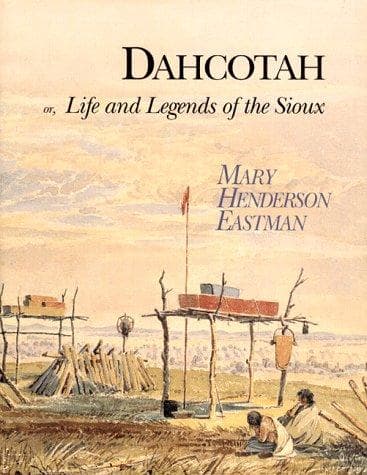
Dahcotah: Life and Legends of the Sioux Around Fort SnellingEastman, Mary H. (Mary Henderson)
History
Dahcotah: Life and Legends of the Sioux Around Fort Snelling
Eastman, Mary H. (Mary Henderson)
Dakota Indians -- Folklore; Dakota Indians -- History; Dakota Indians -- Social life and customs
However defective may be the religion of the Dahcotahs, they are
faithful in acting up to all its requirements. Every feast and custom
among them is celebrated as a part of their religion.
After the scalp-dance had been performed long enough, the Dahcotahs of
the villages turned their attention to making sugar. Many groves of
sugar trees were in sight of their village, and on this occasion the
generous sap rewarded their labors.
Nor were they ungrateful; for when the medicine men announced that they
must keep the sugar-feast, all left their occupation, anxious to
celebrate it. Neither need it be concluded that this occasioned them no
loss of time; for they were all occupied with the construction of their
summer wigwams, which are made of the bark of trees, which must be
peeled off in the spring.
But every villager assembled to keep the feast. A certain quantity of
sugar was dealt out to each individual, and any one of them who could
not eat all that was given him was obliged to pay leggins, or a blanket,
or something valuable, to the medicine man. On this occasion, indeed on
most occasions, the Dahcotahs have no difficulty in disposing of any
quantity of food.
When the feast was over, however, the skill of their doctors was in
requisition; for almost all of them were made quite ill by excess, and
were seen at evening lying at full length on the ground, groaning and
writhing with pain.
CHAPTER III.
The day after the sugar feast, the Owl told his wife to get ready her
canoe, as he wanted to spear some fish. She would rather have staid at
home, as she was not fully recovered from her last night's
indisposition. But there was no hesitating when the war chief spoke; so
she placed her child upon her back, and seated herself in the stern of
the canoe, paddling gently along the shore where the fish usually lie.
Her husband stood in the bow of the canoe with a spear about six feet in
length. As he saw the fish lying in the water, he threw the spear into
them, still keeping hold of it.
When the war chief was tired, his wife would stop paddling, and nurse
her child while he smoked. If the Owl were loquaciously inclined, he
would point out to his wife the place where he shot a deer, or where he
killed the man who had threatened his life. Indeed, if you took his word
for it, there was not a foot of ground in the country which had not been
a scene of some exploit.
The woman believed them all; for, like a good wife, she shone by the
reflected light of her husband's fame.
When they returned home, she made her fire and put the fish to cook, and
towards evening many of the Indians were assembled in the wigwam of the
war-chief, and partook of the fish he had caught in the morning.
Public-domain text, read in full here on John Shaqi.
Reviews
Reviews
No reviews yet
Be the first to share your thoughts on this work.
Elsewhere in the archive
Join the Discussion
Join the discussion
Sign in to leave a comment or review.
Sign InorCreate an account