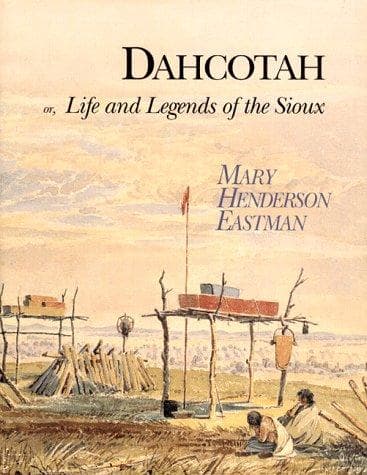
Dahcotah: Life and Legends of the Sioux Around Fort SnellingEastman, Mary H. (Mary Henderson)
History
Dahcotah: Life and Legends of the Sioux Around Fort Snelling
Eastman, Mary H. (Mary Henderson)
Dakota Indians -- Folklore; Dakota Indians -- History; Dakota Indians -- Social life and customs
When they are near their village the war chief raises the song of
victory; the other warriors join their voices to his. The welcome sound
rouses the inhabitants of the village from their duties or amusements.
The warriors enter the village in triumph, one by one, each bearing the
scalp he took; and the stout warrior, the aged woman, and the feeble
child, all press forward to feast their eyes with the sight of
the scalps.
There was a jubilee in the village for weeks. Day and night did the
savages dance round the scalps. But how soon may their rejoicings be
lost in cries of terror! Even now they tremble at the sound of their own
voices when evening draws near--for it is their turn to suffer. They
expect their foes, but they do not dread them the less.
CHAPTER II.
Many of the customs of the Dahcotahs are to be attributed to their
superstitions. Their teepees are always made of buffalo-skins; nothing
would induce them to use deer-skin for that purpose. Many years ago a
woman made a teepee of deer-skin; and was taken suddenly ill, and died
immediately after. Some reason must be found for the cause of her death,
and as no other was known, the Indians concluded that she brought her
death upon herself by using deer-skin for her teepee. They have always,
since, used buffalo-skin for that purpose.
Nothing would induce a Dahcotah woman to look into a looking-glass; for
the medicine men say that death will be the consequence.
But there is no superstition which influences them more than their
belief in Haokah, or the Giant. They say this being is possessed of
superhuman powers: indeed he is deemed so powerful, as to be able to
take the thunder in his hand and cast it to the ground. He dresses in
many colors, and wears a forked hat. One side of his face is red, the
other blue, his eyes are also of different colors. He always carries a
bow and arrow in his hand, but never has occasion to use it, as one look
will kill the animal he wants.
They sing songs to this giant, and once in a long time dance in honor of
him; but so severe is the latter custom, that it is rarely performed.
The following incident will show how great is their reverence for this
singular being. An Indian made a vapor bath, and placed inside of it a
rude image of the giant, made of birch bark. This he intended to pray to
while bathing.
After the hot stone was placed inside of the wigwam, several Indians
went in to assist in giving the bath to their sick friend. One of them
commenced pouring the water on the hot stone, and the water flew on the
others, and scalded them badly; the image of the giant was also
displaced; the Indians never dreamed of attributing their burns to the
natural cause, but concluded that the giant was displeased at their
placing his image there, and they considered it as an instance of his
mercy that they were not scalded to death.
Public-domain text, read in full here on John Shaqi.
Reviews
Reviews
No reviews yet
Be the first to share your thoughts on this work.
Elsewhere in the archive
Join the Discussion
Join the discussion
Sign in to leave a comment or review.
Sign InorCreate an account