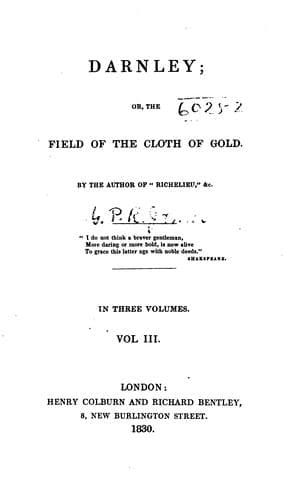
Darnley; or, The Field of the Cloth of GoldJames, G. P. R. (George Payne Rainsford)
History
Darnley; or, The Field of the Cloth of Gold
James, G. P. R. (George Payne Rainsford)
Great Britain -- History -- Henry VIII, 1509-1547 -- Fiction; Henry VIII, King of England, 1491-1547 -- Fiction
"Not so, young man," replied Sir Cesar: "some things are certain, some
are doubtful: some fixed by fate, some left to human will; and those
who see such things are certain, may learn to guide their course
through things that are not so. Thus, even in life, my young friend,"
he continued, speaking more placidly, for at first Sir Osborne's
observation seemed to have nettled him; "thus, even in life, each
ordinary mortal sees before him but one thing sure, which is death. It
he cannot avoid; yet, how wholesome the sight to guide us in
existence! So, in man's destiny, certain points are fixed, some of
mighty magnitude, some that seem but trivial; and the rest are
determined by his own conduct. Yet there are none so clearly marked
that they may not be influenced by man's own will, so that when the
stars are favourable he may carry his good fortune to the highest
pitch by wisely seizing opportunity; and when they threaten evil or
danger, he may fortify himself against the misfortunes that must
occur, by philosophy; and guard against the peril that menaces, by
prudence. Thus, what study is nobler, or greater, or more beneficial,
than that which lays open to the eye the book of fate?"
The impressive tone and manner of the old man, joined even with the
singularity of his appearance, and a certain indescribable, almost
unearthly fire, that burned in his eye, went greatly in the minds of
his hearers to supply any deficiency in the chain of his reasoning.
The extraordinary, if it be not ludicrous, is always easily
convertible into the awful; and where, as in the present instance, it
becomes intimately interwoven with all the doubtful, the mysterious,
and the fearful in our state of being, it reaches that point of the
sublime to which the heart of every man is most sensible. Those always
who see the least of what is true are most likely to be influenced by
what is doubtful; and in an age where little was certainly known, the
remote, the uncertain, and the wild, commanded man's reason by his
imagination.
Sir Osborne Maurice mused. If it be asked whether he believed
implicitly in that art which many persons were then said to possess,
of reading in the stars the future fate of individuals or nations, it
may be answered, No. But if it be demanded whether he rejected it
absolutely, equally No. He doubted; and that was a stretch of
philosophy to which few attained in his day, when the study of
judicial astrology was often combined with the most profound learning
in other particulars; when, as a science, it was considered the
highest branch of human knowledge, and its professors were regarded as
almost proceeding a step beyond the just boundary of earthly research:
we might say even more, when they produced such evidence of their
extraordinary powers as might well convince the best-informed of an
unlettered age, and which affords curious subjects of inquiry even to
the present time.
Public-domain text, read in full here on John Shaqi.
Reviews
Reviews
No reviews yet
Be the first to share your thoughts on this work.
Join the Discussion
Join the discussion
Sign in to leave a comment or review.
Sign InorCreate an account