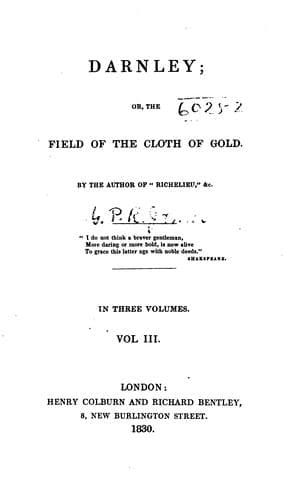
Darnley; or, The Field of the Cloth of GoldJames, G. P. R. (George Payne Rainsford)
History
Darnley; or, The Field of the Cloth of Gold
James, G. P. R. (George Payne Rainsford)
Great Britain -- History -- Henry VIII, 1509-1547 -- Fiction; Henry VIII, King of England, 1491-1547 -- Fiction
Sir Osborne paused and gazed at it for five or ten minutes in silence,
while a variety of very opposite expressions took possession of his
countenance. Now it seemed that the calm beauty of the scene filled
him with thoughts of tranquillity and delight; now that the view
recalled some poignant sorrow, for something very bright rose and
glistened in his eye. At last his brow knit into a frown, and anger
seemed predominant, as, grasping the pommel of his sword with his left
hand, he shook his clenched fist towards the antique battlements of
the castle, and then, as if ashamed of such vehemence of passion, he
turned his horse and galloped back on the road he came.
The moment after he had again entered upon the road to Canterbury, a
sudden change took place in the pace of his horse, and perceiving that
he had cast a shoe, the young knight was forced, although the sun was
now getting far west, to slacken his pace; for the lady who walked
over the burning ploughshares would have found it a different story,
had she tried to gallop over that road without shoes. Proceeding,
therefore, but slowly, it was nearly dark when he reached the little
village of Northbourne, where, riding up to the smithy, he called
loudly for the farrier. No farrier, however, made his appearance. All
was silent, and as black as his trade; and the only answer which
Osborne could procure was at length elicited from one of a score of
boys, who, with open eyes and gaping mouths, stood round, listening
unmoved for a quarter of an hour, while the knight adjured the
blacksmith to come forth and show himself.
"Can I have my horse shod here or not, little varlet?" cried he at
length to one of the most incorrigible starers.
"Ye moy, if ye loyke," answered the boy, with that air of impenetrable
stupidity which an English peasant boy can sometimes get up when he is
half frightened and half sullen.
"He means ye moy if ye can," answered another urchin, with somewhat of
a more intellectual face: "for Jenkin Thumpum is up at the hostel
shoeing the merchant's beast, and Dame Winny, his wife, is gone to
hold the lantern. He! he! he!"
"Ha! ha! ha!" roared his companions, to whose mind Dame Winny holding
the lantern was a very good joke. "Ha! ha! ha! wherever Jenkin Thumpum
is, there goes Dame Winny to hold the lantern. Ha! ha! ha!"
"But how far is it to the inn, my good boy?" demanded Sir Osborne.
"Oh! it's for half an hour up the road, ye see," replied the boy, who
still chuckled at his own joke, and wanted fain to repeat it.
"But are you sure the blacksmith is there?" demanded Sir Osborne.
"Oy, oy!" replied the boy; "as sure as eggs are bacon, if he's not
coming back again. So, if ye go straight up along, you'll meet Jenkin
coming, and Dame Winny holding the lantern. Ha! ha! ha!"
CHAPTER IV.
The first, forgive my verse if too diffuse,
Performed the kitchen's and the parlour's use.
Public-domain text, read in full here on John Shaqi.
Reviews
Reviews
No reviews yet
Be the first to share your thoughts on this work.
Join the Discussion
Join the discussion
Sign in to leave a comment or review.
Sign InorCreate an account