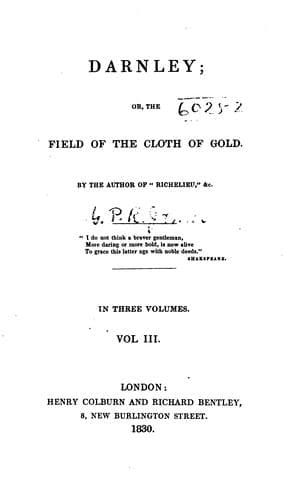
Darnley; or, The Field of the Cloth of GoldJames, G. P. R. (George Payne Rainsford)
History
Darnley; or, The Field of the Cloth of Gold
James, G. P. R. (George Payne Rainsford)
Great Britain -- History -- Henry VIII, 1509-1547 -- Fiction; Henry VIII, King of England, 1491-1547 -- Fiction
Whether it, be true that very high praises of another will frequently
excite some small degree of envy, even in the most amiable minds,
matters not; but Sir Osborne did not seem very easy in his chair while
Lady Constance recited the high qualities of his companion in arms. "I
have heard," replied he at length, "that the fame which Lord Darnley
has acquired, either justly or unjustly, has even reached the ears of
our sovereign lord the king, and has worked much in favour of those
claims which his family make to their forfeited estates. It is well
known that his grace is the flower of this world's chivalry; and as
the young lord is somewhat skilful in the tournois, and at the
barriers, the king has, I hear, expressed a wish to see him, which, if
he should come over, may turn favourably to his cause."
"God grant it may!" said Lady Constance, "although I have never seen
the young gentleman, and though the person who now holds his estates
is cousin to my deceased father----"
"Good God! is it possible?" exclaimed Sir Osborne, "that my lord your
father is dead? But I might have divined it from seeing you here
alone."
Lady Constance sighed. "I am indeed alone in all the world," said
she. "My father has been dead these three years. My Lord Cardinal
Wolsey claims me as ward of the crown; and as I am now in my
one-and-twentieth year, he calls me to a place I hate: the court.
Knowing no one there, loved of no one there, I shall feel like an
inexperienced being in a sad, strange world. But when the time comes
that I may command my own actions, if they will ever let me do so, I
will return to my father's halls, and live amongst my own tenantry.
But to change a painful subject, my good father," she continued,
turning to the clergyman, "were it not well to send a messenger to Sir
Payan Wileton, to let him know that we shall not arrive at his house
to-night, though we will take our forenoon meal with him to-morrow?"
The old clergyman seemed somewhat embarrassed. "I know not what to
do," said he. "'Twould be better not to go at all, yet what can be
done? You promised to go as you went to London, and one ought always
to keep one's promise. So what can the lady do?" And he turned
abruptly to Sir Osborne, not so much as if he asked his advice as if
he made him an apology.
"Why, the lady had certainly better keep her word," answered Sir
Osborne, with a smile; "but you know, my good old friend, that I
cannot judge of the circumstances."
"Ay, true; I forgot," answered the other. "She must go, I am afraid,
though she knows what the man is, and dislikes him as much as any
one----"
At this moment the chamberlain entered, with Lady Constance's woman,
announcing that the tapestry chamber was now warmed and lighted; and
the young lady left them, with many apologies to Sir Osborne for
depriving him of his apartment.
Public-domain text, read in full here on John Shaqi.
Reviews
Reviews
No reviews yet
Be the first to share your thoughts on this work.
Join the Discussion
Join the discussion
Sign in to leave a comment or review.
Sign InorCreate an account