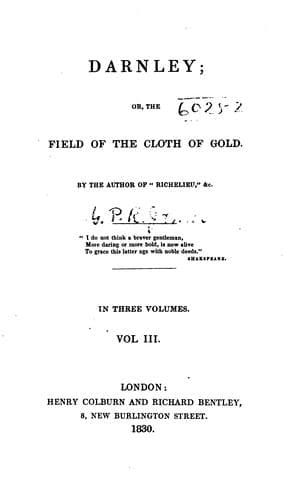
Darnley; or, The Field of the Cloth of GoldJames, G. P. R. (George Payne Rainsford)
History
Darnley; or, The Field of the Cloth of Gold
James, G. P. R. (George Payne Rainsford)
Great Britain -- History -- Henry VIII, 1509-1547 -- Fiction; Henry VIII, King of England, 1491-1547 -- Fiction
To paint him to the mind's eye were very difficult, though to describe
him were very easy; for though I were to say that he was a tall, fair
man, with the old Saxon blood shining out in his deep blue eye, and in
his full, short upper lip, from which the light brown moustache turned
off in a sweep, exposing its fine arching line; though I were to speak
of the manly beauty of his features, rendered scarcely less by a deep
scar upon his forehead; or were I to detail, with the accuracy of a
sculptor, the elegant proportion of every limb, I might, indeed,
communicate to the mind of the reader the idea of a much more handsome
man than he really was; but I should fail to invest the image with
that spirit of gracefulness which, however combined with outward form,
seems to radiate from within, which must live to be perfect, and must
be seen to be understood.
His apparel was not such as his bearing seemed to warrant: though
good, it was not costly, and though not faded, it certainly was not
new. Nor was the fashion of it entirely English: the gray cloth
doublet slashed with black, as well as the falling ruff round his
neck, were decidedly Flemish; and his hose of dark stuff might
probably have been pronounced foreign by the connoisseurs of the day,
although the variety of modes then used amongst our change-loving
nation justified a man in choosing the fashion of his breeches from
any extreme, whether from the fathomless profundity of a Dutchman's
ninth pair, or from the close-fitting garment of the Italian sworder.
The traveller's hose approached more towards the latter fashion, and
served to show off the fair proportions of his limbs without
straitening him by too great tightness, while his wide boots of
untanned leather, pushed down to the ankle, evinced that he did not
consider his journey likely to prove long, or, at least, very
fatiguing.
In those days, when, as old Holinshed assures us, it was not safe to
ride unarmed, even upon the most frequented road, a small bridle path,
such as that which the traveller pursued, was not likely to afford
much greater security. However, he did not appear to have furnished
himself with more than the complement of offensive arms usually worn
by every one above the rank of a simple yeoman; namely, the long,
straight, double-edged sword, which, thrust through a broad buff belt,
hung perpendicularly down his thigh, with the hilt shaped in form of a
cross, without any farther guard for the hand; while in the girdle
appeared a small dagger, which served also as a knife: added to these
was a dag or pistol, which, though small, considering the dimensions
of the arms then used, would have caused any horse-pistol of the
present day to blush at its own insignificance.
In point of defensive armour, he carried none, except a steel cap,
which hung at his saddle-bow, while its place on his head was supplied
by a Genoa bonnet of black velvet, round which his rich chesnut hair
curled in thick profusion.
Public-domain text, read in full here on John Shaqi.
Reviews
Reviews
No reviews yet
Be the first to share your thoughts on this work.
Join the Discussion
Join the discussion
Sign in to leave a comment or review.
Sign InorCreate an account