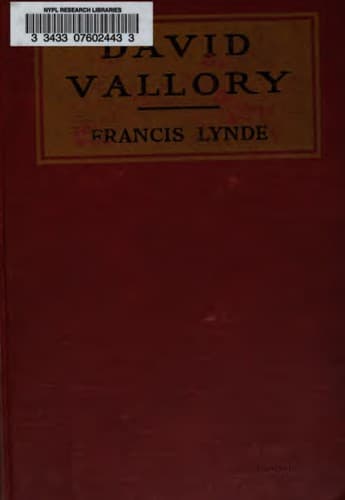
Civil engineers -- Fiction; Ethics -- Fiction; Love stories; West (U.S.) -- Fiction
“I’m not talking about marrying; I’m talking about the soul of a man,”
was the quick retort. “It is in your hands to keep David Vallory true
to his ideals, or to make him like other men who have one conscience
for their personal relations and another for business. David is more
loyal to you than your own son would be, if you had one; after what
you did for his father last summer he would go through fire and water
for you. It isn’t right or just for you to use so fine a thing as his
gratitude and make it the means of his undoing!”
Again the big man in the opposite chair fell silent. When he spoke
again it was to say:
“You’re all wrong, Vinnie, girl; wrong and a little bit wrought up. You
are carried away by your own impossible notions of the golden-rule in
business, and all that--things that you know about only by hearsay. You
won’t take it amiss if the old daddy has his notions, too, will you?
Just the same, we’re chums, little girl, and we won’t fight about a
little thing like that. I’ll see to it that David doesn’t have to stick
his fingers into the tar-barrel, if that’s what you want. Now run
along to bed.”
The upshot of this heart-to-heart talk between the father and daughter
had been a letter to Silas Plegg, which followed David Vallory so
promptly in his westward flight as to be in the first assistant’s hands
when he made his introductory round over the big job with the new
chief. It was a letter to be read, remembered, and burned; but if David
Vallory could have seen it, it would have explained Plegg’s attitude,
and many other things which grew more and more puzzling as time went
on.
X
The Miry Clay
Having himself so recently made the journey from Chicago to the
Timanyoni, David Vallory knew that he could count upon at least two
clear days in which to gather up the loose ends and otherwise to
prepare his huge working machine for a critical inspection by the
president of the company. To that end he called a conference of the
members of his staff and applied the spur. The big boss was coming, and
it was up to them to show him the machine in perfect working order. If
there were any loose ends, now was the time to tie them in.
“There’s only one thing that I’d like to see changed,” said Crawford,
the grading expert who had charge of the line building on the lower
end of the cut-off; “that is this crazy practice of paying off every
two weeks instead of once a month. I count on at least a ten per
cent reduction in my gangs for two or three days after every second
Saturday--which is about the length of time it takes the high-rollers
to get rid of their money in the Powder Can dives.”
“Leaks of that kind are precisely what we are trying to find and stop,”
the new chief broke in. “Any suggestions?”
There were several made by different members of the staff, but they
were all variations upon the same theme, namely, some method by which
the too-frequent pay-days might be abolished.
Public-domain text, read in full here on John Shaqi.
Reviews
Reviews
No reviews yet
Be the first to share your thoughts on this work.
Join the Discussion
Join the discussion
Sign in to leave a comment or review.
Sign InorCreate an account