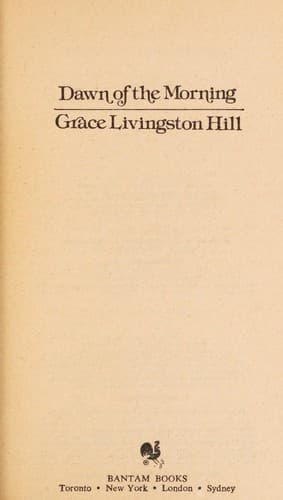
Six years had passed since Dawn, a child of ten, had come to the school,
and she had never gone home. It had been her own wish, and for once her
father and stepmother were willing to accede to her. To both, the sight
of her and the thought of her were painful. Her father had visited her
every year and brought with him a full supply of the modest wardrobe
that the school allowed, and Dawn had money to meet all her necessary
expenses. She lived a sort of triple life—one in the world of her
studies, in which she sometimes took deep delight, often going far ahead
of her classes because she wanted to see what came next; one in the
world of play, where she was leader in all sorts of mischief, getting
the older ones into endless difficulties with the teachers, and
protecting the little ones, even to her own detriment at times; the
third life was lived alone in the fields or the woods, where she might
sit quietly and look up into the blue sky, listening to the music of the
winds and the birds or the sad chirp of a cricket, taking a little
grasshopper into her confidence, talking to a friendly squirrel on the
maple bough overhead—here was where she really lived. On the walls of
her memory were hung strange, sad pictures of the past. Always on such
occasions the mother all in white, with starry eyes, hovered over her,
and seemed to listen to the wild longing that beat in her young heart,
and to pour a benediction upon her.
She could not think of her father except sadly or bitterly, and so as
much as possible she put him out of her thoughts. By degrees, as she
came to see on his annual visits how old and careworn he was grown, how
haunted and haggard were his eyes, she grew to pity him, but never to
love, for her mother had been her idol, and he had killed her mother.
That the girl could not forget, though as she grew older she felt with a
kind of spiritual instinct that she must forgive. She felt it was his
own blindness and stupidity that had done it, and that he was suffering
some measure of punishment for his deed. She never actually put these
thoughts before her in so many words. They were rather a sort of
growing undertone of consciousness in her, as her mental and spiritual
faculties developed.
In one year more she would be through with the school course. For some
time she had been dreading the thought, and wondering what would come to
her next? If she might go somewhere and "teach school,"—but she felt
certain her father would never allow that. He was proud and held ideas
about woman’s sphere. Though she could scarcely be said to know him
well, still she felt without asking that he would never consent.
Sometimes she even entertained vague thoughts of running away when she
should be through school, for the idea of dwelling under her father’s
roof again, under control of the woman who had usurped her mother’s
place, she could not abide.
Public-domain text, read in full here on John Shaqi.
Reviews
Reviews
No reviews yet
Be the first to share your thoughts on this work.
Join the Discussion
Join the discussion
Sign in to leave a comment or review.
Sign InorCreate an account