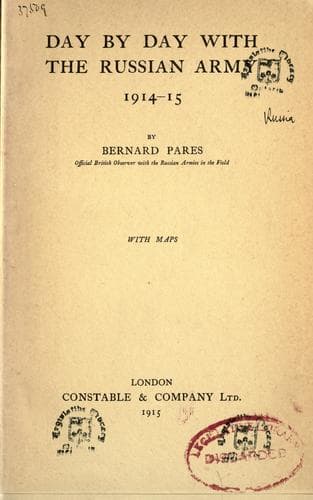
Day by Day with the Russian Army, 1914-15Pares, Bernard
History
Day by Day with the Russian Army, 1914-15
Pares, Bernard
World War, 1914-1918 -- Campaigns -- Poland; World War, 1914-1918 -- Personal narratives, English
The staff of the Xth Division was housed in a white-walled cottage at
the end of the little town. After the usual glasses of tea and talk
of England, we set out with a small cavalcade for the front. The long
street was very definitely Hungarian. It was not only the notices and
the shops, with surname written first, among which I saw the historic
name of Rakoczy, probably a Jew; but that the line of the houses, the
river and the landscape were all new to one coming from Russia.
We rode fast along the double track of railway, and very quickly
reached our first halting-place. Diverging to the high road, which
was also fairly hard and dry, we soon left our horses and proceeded
on foot. The road was so good and straight, the weather was so fine,
and the beautiful hills so peaceful, that, though talking all the time
about the war, we somehow forgot that we were in it, when suddenly,
from a high hill that seemed quite close to us, there crashed a shell
about thirty yards from us. The little lurid flame that preceded the
explosion burned long enough to let us throw ourselves against the
bank, which was bright with pretty blue flowers. We found we had
exactly reached the front of our positions and made our way under
shelter up a slope. The men were at work on their breastworks, which
were very different from those of the Galician plain. On this higher
ground, almost at any point the spade soon came on springs of water
which filled the hole in a few minutes. In such places the breastworks
are ordinarily what is called horizontal; they are constructed of
brushwood and spruce fir, and give hardly any shelter. The earth-huts
are replaced by little arbours of fir boughs, which are very much
more difficult to warm, though from the captured Austrian trenches,
unfortunately facing in the other direction, there have been taken
quite a number of excellent little stoves. As the new Russian lines
were only recently occupied, they were still in a very primitive state;
in the wood that stretched in front, trees were still being cut to
the stump to serve as posts for the wire-entanglements, and the lines
themselves were not as yet at all continuous. Shells continued to fall
at short intervals for some time, and a private, killed while at work,
was brought up for burial. The colonel pointed the moral of getting the
shelters finished as soon as possible.
When the firing died away, we walked along the outside of the
lines; the task of sentries and scouts was a difficult one, for the
trees stood close together. After a halt, I was taken further by a
business-like officer with worn uniform and steely blue eyes, and, with
his approval, I passed a word or two of greeting from the English army
to the groups of soldiers at work. Several of the men asked me to send
a like greeting back.
Public-domain text, read in full here on John Shaqi.
Reviews
Reviews
No reviews yet
Be the first to share your thoughts on this work.
Elsewhere in the archive
Join the Discussion
Join the discussion
Sign in to leave a comment or review.
Sign InorCreate an account