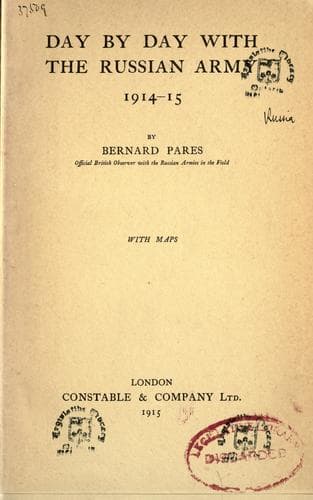
Day by Day with the Russian Army, 1914-15Pares, Bernard
History
Day by Day with the Russian Army, 1914-15
Pares, Bernard
World War, 1914-1918 -- Campaigns -- Poland; World War, 1914-1918 -- Personal narratives, English
As we went forward, this little procedure became more detailed. The
idea was taken up with enthusiasm by the commanders of companies,
especially after I had been conducted, staff in hand, over a deep
gully which separated us from the next regiment. Here each company was
called outside its trenches and drawn up facing the enemy. I gave the
salute, "Health, brothers"; and the usual answer came in a thundering
peal. I told them how grateful we were for everything that they had
sacrificed and everything that they had done for our common cause,
and said that we wanted to be in time to do our full share on land,
that our new big army was ready, and that we were going to advance as
they had done. There is no difficulty in making simple things clear to
Russian soldiers. They answered with their "Glad to do our best," and
the "Hurrah!" which was so vigorous as to bring the Austrian machine
guns into play; I am glad to say, without results. Several of the men
came and talked to me in groups later; they felt the effects of their
hard work and the heavy losses that go with attack, but their spirit
was a conquering one, and all the more impressively so, because of the
hardships in which I saw them. Later, when I saw the Commander of the
Army, who had run a risk of being captured close to this very ground,
he asked me to continue to give these greetings, "to hearten for the
common cause," and arranged for me to get early news of any successes
on the western front.
I slept with the usual brotherly group of officers in a little
forester's hut, a hundred yards from the comparatively open front; on
the outside of the door was chalked the word "Willkommen," which read
like an amusing invitation to the enemy. We all slept on the floor,
but I was accommodated with a litter, which made an excellent bed. The
porch served as first-aid point, and when the firing was resumed in the
morning, a wounded man was brought in here.
Before I went further, the Brigadier-General sent me by telephone a
warm greeting, to be communicated to England.
_April 20._
The reader will remember "The Birds," a very tight place held by the
L regiment beyond a river on another front. The L's had done no end
of work and had suffered heavily long before I visited them at "The
Birds." There, too, they lost many men--about 1500 out of 4000--in an
action which followed on their occupation of those positions and in the
weeks of cannonade which they endured there.
I was aware that the L's were now in the Carpathians and close to
me. The two regiments whose lines I had traversed had lost many in
this hill warfare. Where a hill is taken, the enemy's losses, though
probably more than double the Russian, are rather in surrenders than
in killed and wounded. A hill attack, which is beaten off by superior
numbers, means heavy sacrifices.
Public-domain text, read in full here on John Shaqi.
Reviews
Reviews
No reviews yet
Be the first to share your thoughts on this work.
Elsewhere in the archive
Join the Discussion
Join the discussion
Sign in to leave a comment or review.
Sign InorCreate an account