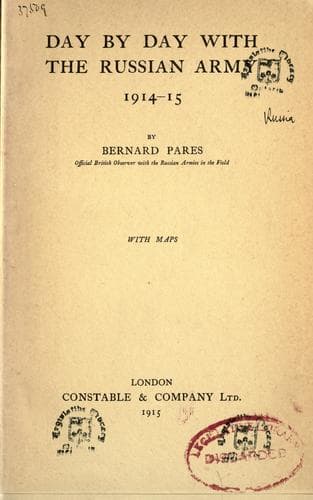
Day by Day with the Russian Army, 1914-15Pares, Bernard
History
Day by Day with the Russian Army, 1914-15
Pares, Bernard
World War, 1914-1918 -- Campaigns -- Poland; World War, 1914-1918 -- Personal narratives, English
I clambered over another of the steep intersecting gulleys. A group
of S's stood waving their farewells. There was a bit of bare slope
facing the Austrian plateau, and then I came on the first shelter of
the L's, quite a comfortable mud hut. The young officer, who had come
to meet me, was an acquaintance, and he sat down and told me about the
men I knew. In a single night attack on the height in front of us,
two-thirds of the officers that I had known had gone down, and about
half the regiment. Name after name came up with the brief record, "He's
killed." We lay on the straw--in nearly all other huts here there
were only boughs of fir--and he told me the whole story. The hill
was almost inaccessible, the works were long prepared and elaborate,
the Germans had hurried up large forces here; yet the attack all but
succeeded. "All but," and no results but losses. At Rava Russka and on
the San the L's had given of their best, and decisive successes had
followed. The hill opposite had cost more and still faced us. It is one
of the saddest of thoughts, that the bravest of all, the men who go
furthest, must lie where they fell. Yet the L's, who in the course of
a few days have again been brought up to full strength by the enormous
reinforcements which Russia continues to pour into the army, will have
written their name on the Hungarian war in as lasting colours as on the
Galician. We are over the crest; we are fighting in the main downwards;
we touch a vital spot; and we are going forward.
There is nothing which makes one feel all this better than to pass
along the lines of a regiment so battered, still in position at the
time when I visited it; nay, more, occupying for the moment far more
than the natural extent for its full strength, and occupying it as
a conqueror with swiftly thrown-up works that only provide for an
elementary shelter. And the battle is not offered; the enemy sits on
his heights and makes no counter-stroke to push his temporary advantage
home.
I write of a time which has already passed; for the whole position
is very different now. But I say the L's were conquerors. There were
nothing like enough of them for a continuous line; so they had picked
out all those sections which commanded any possible advance of the
enemy, and held them as masters. For the intervals, the gullies, they
detached large scouting parties which met any forward move halfway.
The work which this meant for all will remain with me as giving a
picture of a Russian regiment after a check. All the officers and men
were alert and looking to the next move in the game. A soldier who
guided me, confident and intelligent, stopped only for a moment in
his conversation, to say: "But, as a matter of fact, sir, there are
very few left of us." Regiments that can take punishments like this,
communicate their spirit and tradition to those of the new recruits who
are so fortunate as to join them.
Public-domain text, read in full here on John Shaqi.
Reviews
Reviews
No reviews yet
Be the first to share your thoughts on this work.
Elsewhere in the archive
Join the Discussion
Join the discussion
Sign in to leave a comment or review.
Sign InorCreate an account