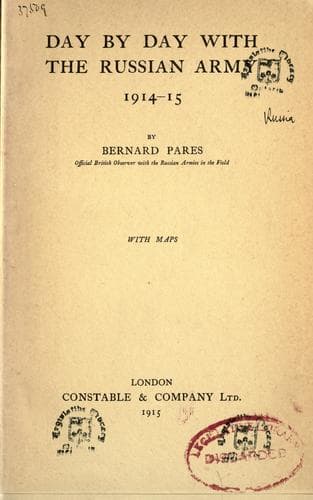
Day by Day with the Russian Army, 1914-15Pares, Bernard
History
Day by Day with the Russian Army, 1914-15
Pares, Bernard
World War, 1914-1918 -- Campaigns -- Poland; World War, 1914-1918 -- Personal narratives, English
What was happening to the O's was not so clear; so after watching the
shells and shrapnel bursting along the line and on the slope for some
hours, we descended by some winding gullies, drawing a shrapnel as we
passed over a low shoulder, and soon reached the staff of the O's.
Under the nearer wall of a hut, a group of officers was working the
telephones, while a number of soldiers lay on logs around. The Colonel
came forward to me with a preoccupied smile: "A convoy for the flag,"
he explained, and turning to his men; "you have the flag there?" Then
he took me into the open and pointed at the ridge some six hundred
yards away: all his left was at grips with the enemy who had come
through at several points, and on the right his men were fighting at
the close range of two hundred yards in the wood beyond the crest.
We crouched behind the houses amid a constant roar of shells bursting
all round us, and firing some of the neighbouring huts. The telephones
worked incessantly. Now each of the battalion commanders reported in
turn--one, that his machine guns had been put out of action, another
that there were gaps in his line, a third that he was holding good,
but hard put to it. The Colonel explained that his last reserves were
engaged. A message came that his right flank was open and was being
turned. He seized the telephone and called to the reserve regiment:
"Two companies forward at the double," reporting his action directly
to the staff of the Division. There was a peculiar humanness about
all these messages; in form they were just ordinary courteous
conversation. The question which brought the most disquieting answers
was "Connexions." The Z Colonel reported that his line was penetrated
at more than one point, but was holding out. The R telephone gave no
answer at all. Life there was unlivable, the trenches were destroyed,
and on my way I had heard from soldiers a report that when taking
ammunition to the R's they had seen the Austrians in our lines. Shells
and shrapnel were crashing all round us, especially on our rear; a
great cloud rose where I had sat at the top, and a hut that I had
passed on the way down broke out in full flame. Nearer down there fell
four black explosives at regular distances of fifty yards, "the four
packets" as one officer called it. Our cover would all have gone with
a single shot, and the men crouched to avoid the falling splinters
from each shell. In this depressing atmosphere there went on the
conversation between the Colonel and the divisional staff: "I can get
no contact, with the R's. Cavalry is reported on both of my flanks.
The R's have had to retreat." The answer was an order to retire at
nightfall. Three hours at least had to run. The order was communicated
in French over each battalion telephone. The Colonel apologised for
his elementary French; anyhow it was the French of a brave man. As
disquietudes increased, the permission came to retire at once; but the
Public-domain text, read in full here on John Shaqi.
Reviews
Reviews
No reviews yet
Be the first to share your thoughts on this work.
Elsewhere in the archive
Join the Discussion
Join the discussion
Sign in to leave a comment or review.
Sign InorCreate an account