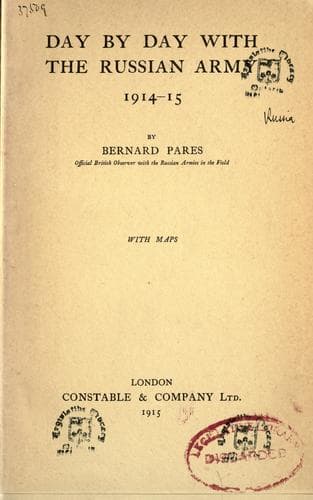
Day by Day with the Russian Army, 1914-15Pares, Bernard
History
Day by Day with the Russian Army, 1914-15
Pares, Bernard
World War, 1914-1918 -- Campaigns -- Poland; World War, 1914-1918 -- Personal narratives, English
Colonel answered that this could not be done: he was in hot defensive
action, and the enemy would follow on his heels; at present he was
holding his own.
Twice on the telephone the fatal word "surrounded" had been used. My
hosts urged me to go. "We have each a different duty," they said.
It was with little heart that I faced for the slope, turning a few
yards off to salute these brave men once more. They were some wounded
struggling up the gullies, one with a maimed foot, whom we helped along
but who had to sit down at times and smoke. As we began to approach
shelter, we suddenly saw on the hills to the west of us men coming
down the slope towards us. "Perhaps ours, perhaps the enemy," said
my Cossack, who never turned a hair throughout the day. We got our
lame man up the big hill, but as soon as we had passed the crest he
said that his strength failed him, and sat down with several others
round a well. The next thing was to look for the motor. We were now
in comparative safety; for we were out of the line of fire, and the
valley to the north of us was full of our own people. Officers galloped
forward, looking at the line of our retreating field trains. In the
valley there was a long train of wounded. I at last found our motor in
the midst of it. We packed in the men with the worst wounds that we
noticed; they lay without a groan, and one old soldier said: "Thanks
to Thee, O Lord; and eternal gratitude to you." A young soldier with
an eager face pressed forward with a letter, begging us to take his
wounded officer, whom he had brought five miles from the distant lines
of the R's. "Harchin"--that was his name, was like a loving son, with
his captain, walking by our side or standing on our step for mile after
mile and all the while helping to hold the litter in position. He told
us that no living man could have driven the R's from their position:
but that the whole area was covered with shells till trenches and men
were levelled out of existence. The companies left comparatively intact
had all joined on to the O's. Of the O's themselves we could only hear
vague rumours; it was said that most of them had made their way back.
There was no panic, no hurry in the great throng, as it retired.
Each was ready to help his neighbour. Crossing a long hill we had to
transfer some of our wounded to an empty cart which we commandeered,
the men moving without a word. In the night Harchin kept holding up his
officer and giving any comfort that he could. "It's quite close now,
your nobility, it's a good road now," he would say. We reached a hut
where the kind Polish hostess showed us beds for our wounded; Harchin
was constant and tender in his care, and I left the two together to
await the arrival of the doctor. A private with a crushed face refused
to lie on his bed for fear of spoiling it, and sat holding his bleeding
head in his hands.
Public-domain text, read in full here on John Shaqi.
Reviews
Reviews
No reviews yet
Be the first to share your thoughts on this work.
Elsewhere in the archive
Join the Discussion
Join the discussion
Sign in to leave a comment or review.
Sign InorCreate an account