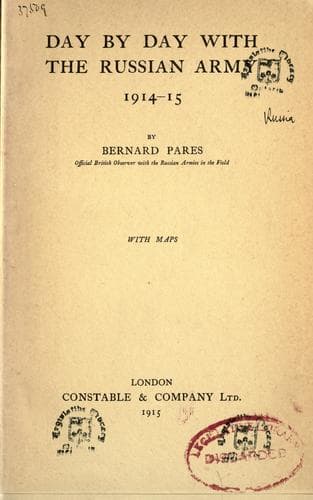
Day by Day with the Russian Army, 1914-15Pares, Bernard
History
Day by Day with the Russian Army, 1914-15
Pares, Bernard
World War, 1914-1918 -- Campaigns -- Poland; World War, 1914-1918 -- Personal narratives, English
Through the darkness and past an incessant train of army carts, which
without any shouting did all they could to give us passage, I made my
way to the corps of the staff and to the next Division; where I slept
long into the morning. It was only later that we knew the full scope of
our losses. The Division had against it double its number of infantry
and an overwhelming mass of heavy and light artillery. It had held its
trenches till it was almost annihilated.
_May 4._
When I woke up in the morning, the deserted school where the staff had
stretched their beds was alive with work and anxiety. The lines lay
only a mile and a half outside the town of Biecz, and the Germans
and Austrians were making a tremendous attack on them, pounding them
with the heaviest artillery and advancing on them in close column
again and again. The leader of this Division is a fighting General,
robust, active and of great composure. The Staff was very close up
to the front, and our own immediate movements depended on to-day's
results. As we were being shelled, we went for lunch to a neighbouring
Polish monastery, a pleasing white-walled building on a hill. It was
deserted but for one or two monks; and its cloisters and wall-paintings
and stations of the Cross were like an oasis far from the war. I lay
down in one of the empty rooms and had some more hours of sleep.
On my return to the school building I found that the situation was
critical. From the balcony the General viewed the lines and gave some
short directions. In the summer weather one watched groups of soldiers
descending from the neighbouring hill and making for the bridge at the
foot of our house. They were ours and were being relieved; and they
formed up into order and were addressed by an officer before crossing
the bridge. The enemy had been beaten off in every infantry attack, but
many parts of the lines were now non-existent, having been reduced to a
series of shell-pits by the German artillery.
With a young Cossack I started out for the D regiment. The
picturesque little town--all the Polish towns are full of pleasing
architecture--was crowded with troops, and the atmosphere was one of
uncertainty. Men were sheltering from the hot fire all along the banks
of the sunken road. On the top of the hill were a few huts through
which we threaded our way, dodging an exposed area where shells burst
continually. Further on we found to the right of us a deep valley thick
with lofty trees. On the edge of this wood were a number of soldiers
who had lost touch with their regiments. We stopped them to find our
way. The D regiment, we learned, was no longer at the front; and indeed
on this side we should not find any lines at all. We were told that the
Austrians were already in the wood, which later proved to be true. The
fire was heavy here, splinters falling upon us through the trees; and
the stragglers hurried away.
Public-domain text, read in full here on John Shaqi.
Reviews
Reviews
No reviews yet
Be the first to share your thoughts on this work.
Elsewhere in the archive
Join the Discussion
Join the discussion
Sign in to leave a comment or review.
Sign InorCreate an account