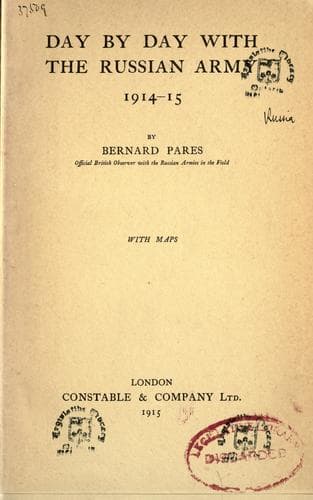
Day by Day with the Russian Army, 1914-15Pares, Bernard
History
Day by Day with the Russian Army, 1914-15
Pares, Bernard
World War, 1914-1918 -- Campaigns -- Poland; World War, 1914-1918 -- Personal narratives, English
I woke in a farmhouse, in a village that was filled with the divisional
field train. The Divisional General had gone off early to the front
to rectify the new positions. The news that came in was uncertain and
anxious. The first hut which the General and his staff had entered had
been made untenable by the enemy's artillery. The second hut that he
visited was also set on fire. No further news of him came till late in
the evening that he had barely escaped capture.
Word came that the staff would be moved further back. The field trains
were set in motion, and we travelled without any kind of confusion
across a beautiful range of wooded hills. We stopped more than once to
see the fight that was going on below us. It was a blazing line of fire
and smoke, the twin yellow and white bursts of the Austrian shrapnel
being almost lost in the white or black smoke of the German artillery.
We travelled very slowly and for a good part of the day; officers and
men were full of vexation at having to retire before troops which they
felt themselves capable of beating with any equal conditions: among
themselves there prevailed a simple good humour.
I rode at different times with the adjutant, the chief of the field
train, and the divisional doctor, all of whom were perfectly cool and
collected. We made different wayside halts, and in the afternoon drew
up in a large village also full of field trains. Here we took rest and
refreshments, while different rumours came in from all quarters: and
in the evening I drove in for news to the staff of the army at Jaslo,
which was now close to the enemy.
From nearly all the regiments of the corps which I had accompanied,
great losses were reported; on the other hand, practically every
infantry attack had been driven off with great loss to the enemy.
The trenches had been left only when the enemy's artillery had made
them untenable. In some parts the systematic ploughing up of whole
given areas had gone so far behind our lines that even approach to the
trenches had been made impossible.
The game was not lost even on this ground, and immediate measures had
been taken for counter-attacks the following day. Meanwhile Jaslo was
under an intermittent but violent bombardment of aeroplanes; and all
the hospitals were being moved to the rear.
I learned that the enemy were making a similar artillery attack on
Tarnow, where I had spent several of my periods of Red Cross work at
the hospitals. The Russian workers in the local Civil Spital had stayed
on to the last and were now under a hot fire, and it was desired that
they should be moved without delay. The Red Cross authorities had been
told that this detachment could be guaranteed "against capture for the
present, but not against artillery fire." I was commissioned to go and
move it.
Public-domain text, read in full here on John Shaqi.
Reviews
Reviews
No reviews yet
Be the first to share your thoughts on this work.
Elsewhere in the archive
Join the Discussion
Join the discussion
Sign in to leave a comment or review.
Sign InorCreate an account