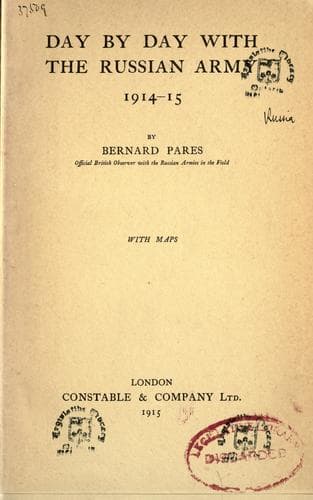
Day by Day with the Russian Army, 1914-15Pares, Bernard
History
Day by Day with the Russian Army, 1914-15
Pares, Bernard
World War, 1914-1918 -- Campaigns -- Poland; World War, 1914-1918 -- Personal narratives, English
I found the General of the Transport at the railway station full of
work, but cool and business-like. His was one of the most difficult
tasks, but there was no better head in the Third Army. At three in the
morning he came to tell me that a motor was at my disposal at once.
At my first stop I was asked to take with me an official of the Red
Cross who had been deprived by contusion of his voice and hearing. He
was in full possession of his senses and wrote down his wishes. He had
been under fire with three hundred wounded in the village where I had
slept the night before. There were other reports more disquieting. In
one advanced bandaging point the German soldiers had burst in, full of
drink and rage, and had bayoneted the staff and, as we were told, the
doctor.
In the early morning I reached an ambulance point managed almost
entirely by the members of one family, the father (who was a retired
divisional doctor), the mother, and their son. To them I handed over my
unhappy companion. Here I had anxious news of the hospital for which I
was making. Tarnow was four miles from the front; on the German advance
nine shells had been fired on the hospital in one day, and one of them
had struck the operating-room and wounded the lady doctor.
I drove on to the staff of the neighbouring corps to see about
transport, and thence to my destination. There was an ominous absence
of troops, other than retreating field trains. The inhabitants were
all in the streets, alive as it seemed to me with excitement and
expectation. As I drove up, I saw the five plucky sisters waiting on
their balcony. They had already sent away all their Russian wounded and
were ready to start. The wounded civilians, who were Austrian subjects,
and some wounded Austrian soldiers had been housed in the cellars and
would be left to the care of their own people.
This work had all been done in two hours directly after the last
bombardment. The sisters had been given a second George medal for
bravery. They spent the evening on a hill watching the artillery attack
on our troops. It was a ring of fire that simply demolished the
trenches. Attack after attack of the enemy's infantry was beaten off.
One detachment, sent to the support of a neighbouring regiment, found
some of the defenders asleep under the cannonade: they had beaten off
eight attacks. The N Regiment was decimated, but full of spirit.
All this I learned later. Without any kind of haste or commotion, the
sisters said good-bye to the Austrian wounded and to the kind Polish
sisters who had worked so long with them, and we all started in my
motor. We were soon out of the range of fire, and continued our journey
until we had reached the new headquarters of the Red Cross, where we
were joined a day later by the staff of the army.
_May 9._
Public-domain text, read in full here on John Shaqi.
Reviews
Reviews
No reviews yet
Be the first to share your thoughts on this work.
Elsewhere in the archive
Join the Discussion
Join the discussion
Sign in to leave a comment or review.
Sign InorCreate an account