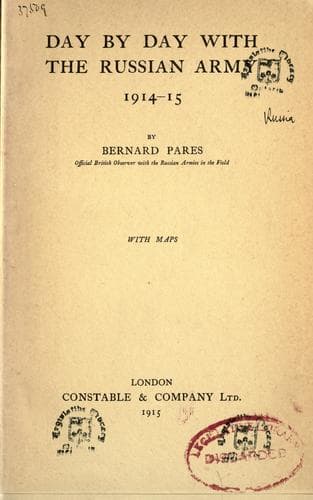
Day by Day with the Russian Army, 1914-15Pares, Bernard
History
Day by Day with the Russian Army, 1914-15
Pares, Bernard
World War, 1914-1918 -- Campaigns -- Poland; World War, 1914-1918 -- Personal narratives, English
The details of the Austro-German advance on the Third Army are
now clearer. The Russian advance over the Carpathians was not met
directly, but by a counter-advance on its flank. Here five army corps
were concentrated, some of the fresh troops being drawn from reserve
divisions on the French front, especially in the neighbourhood of
Verdun. The journey across Germany is reckoned at three to five days,
according to whether or not one includes the mountain marches at the
end of the railway journey. Prisoners of the Prussian Guard tell me
that they were given special training in hill climbing before they
started.
Meanwhile, the long months of comparative inaction had been employed in
bringing up the heaviest German and Austrian artillery, both of which
were last summer concentrated on the western front, and getting the
range not merely of the Russian lines, but of squares which covered a
good part of their rear. This was a long and toilsome operation, as
these guns cannot be moved except by railway or, with great efforts
and under good weather conditions, on roads which have a certain
consistency. The potentialities of these guns are in any case limited;
they cannot easily follow up an advance or get away in case of a rout.
They can force the evacuation of a given area, but it may be possible
to manoeuvre in such a way that the general position is but little
changed.
[Illustration: THE GREAT ATTEMPT OF THE CAUCASIANS]
It will be remembered that the Austrians during the idle months have
been covering the Russian lines in front of them with a ceaseless
cannonade. This counted for little at the time. The Austrian
artilleryman has only lately developed any accuracy; for a long time
they continued in the most stupid errors of detail; they hardly ever
placed a Russian battery, and evidently the process of range-finding
has been long and very expensive. The Austrians rarely attempted
infantry attack, knowing that they always met their masters; thus their
ceaseless cannonade was not a preparation for an infantry offensive;
and the Russians might even, if necessary, leave their trenches only
partially occupied during the day, keeping less in those parts which
were under the hottest fire and holding the whole line in force only by
night.
It was a very different story when the initiative on this side was
undertaken by the Germans, who use artillery as a preparation for
desperate attacks in close column. The difference in accuracy between
the German and Austrian artillery fire was very soon discovered to the
Russian regiments in front of them; and it was known that the Prussian
Guard Reserve was here. The trenches were, therefore, occupied in full
and held until they became untenable.
Public-domain text, read in full here on John Shaqi.
Reviews
Reviews
No reviews yet
Be the first to share your thoughts on this work.
Elsewhere in the archive
Join the Discussion
Join the discussion
Sign in to leave a comment or review.
Sign InorCreate an account