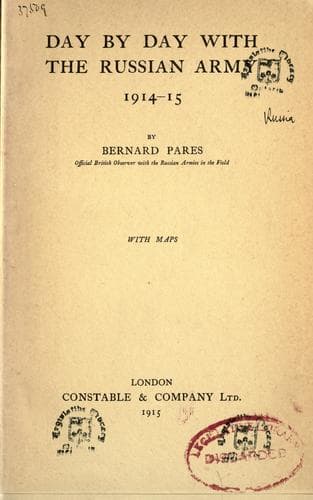
Day by Day with the Russian Army, 1914-15Pares, Bernard
History
Day by Day with the Russian Army, 1914-15
Pares, Bernard
World War, 1914-1918 -- Campaigns -- Poland; World War, 1914-1918 -- Personal narratives, English
We now got on to the main questions; he was very ready to discuss them
and spoke perfectly frankly. I asked on what side Germany could hope
for any deciding success. He admitted at once that no such point,
of the kind that Napoleon used to look for, was to be found on any
side, and he maintained that from the outset, both militarily and
politically, Germany was fighting a purely defensive war, of course by
frequent counter-offensives. In that case, I suggested, Germany could
only have peace by our offering it, that is, by our getting tired of
the war; and surely it was unfortunate that she had all of us against
her at once. In reply he reminded me of the German word _Streber_,
which means a restless pushing person who is always disturbing and
annoying others. Economically, he said, the struggle for life in
Germany had become almost impossible, of which he himself had seen many
instances. Some outlet was essential, and this England and the other
Powers had united to prevent. I said that for us English the issue was
whether Germany should have things which we at present possess, and
that we were not likely to give them up without fighting. He quite
accepted this. Germany, he said, was like the troublesome boy of the
school, who was dissatisfied and had a grievance, and was always making
things unpleasant for all the rest, so that there was no wonder if
he was not liked. I suggested that this went too far, if his own old
allies, such as Italy, turned against him. He expressed a natural
resentment against Italy, and said that anyhow here right was on the
side of Germany, who would continue to defend herself to the end. I
answered that we might disagree as to the question of right, but that
I could not understand how any successful issue could be hoped for
under such conditions. He was of my opinion, and twice spoke of the
war as a "catastrophe." I asked, then, why Germany should persist in
a policy which had obviously, especially in the case of Italy, proved
to be a misguided one; we all felt admiration for the magnificent
fighting power of the German army, which might have dealt successfully
with us separately; but it had been set an impossible task. He replied
that England had a long experience as a state and that policy with her
was well thought out; Germany had only some forty years of a united
existence behind her, and the policy which had led to "the catastrophe"
could not, as a policy, be defended. I asked whether it was likely to
be changed, and to this I neither expected nor got any answer. But
it was interesting that, in spite of the great successes in western
Galicia, he described the present mood of the army as nothing like the
first great outburst of enthusiasm at the beginning of the war.
Public-domain text, read in full here on John Shaqi.
Reviews
Reviews
No reviews yet
Be the first to share your thoughts on this work.
Elsewhere in the archive
Join the Discussion
Join the discussion
Sign in to leave a comment or review.
Sign InorCreate an account