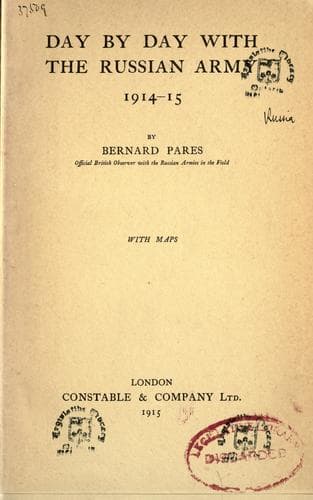
Day by Day with the Russian Army, 1914-15Pares, Bernard
History
Day by Day with the Russian Army, 1914-15
Pares, Bernard
World War, 1914-1918 -- Campaigns -- Poland; World War, 1914-1918 -- Personal narratives, English
I was later given an opportunity of examining a German private (a
Hanoverian). This man had been asleep when the Russians stormed his
trenches. I was interested both in the readiness of his answers, which
he gave with a smiling face, and in the answers themselves. The German
heavy artillery was all beyond the San, and troops were being sent away
to the Italian front. Food was poor in Galicia; all the soldiers were
for peace, and there was the same refrain in all the letters received
from home. He had been on the western front near Reims and had made
the railway journey to Neu-Sandec (Nowy Sacz) in five days. He spoke
with especial respect of the first English troops, of the Russian field
artillery and of the accuracy of the French heavy artillery.
_June 7._
I had a talk with a staff officer of the E E Corps on the fortunes of
his corps and on the German methods of advance. The corps had not been
hit so hard as some others by the Austro-German impact; it helped to
cover the retreat to the San, and stood to its ground beyond the river
until one of its neighbours retired. When the enemy had thus got a
footing beyond the river, the E E Corps made a counter-attack vigorous
and successful. But the enemy pushed the next corps still further
back, so that the E E's had also to rectify their line. However, they
continued to make counter-attacks, at one point gaining about a mile
of ground, and they were still holding good. They had at least the
satisfaction of holding the forces of the enemy which were opposed to
them, so that these troops could not move further along the Russian
line to complete their offensive movement. This record is typical of
very much of the Galician fighting, which is full of such ups and downs
of attacks and of counter-attacks, and only reached decisive results by
the employment, at given points, of an overwhelmingly superior heavy
artillery.
The German method is to mass superior artillery against a point
selected and to cover the area in question with a wholesale and
continuous cannonade. The big German shells, which the Russian soldiers
call the "black death," burst almost simultaneously at about fifty
yards from each other, making the intervening spaces practically
untenable. The cannonaded area extends well to the rear of the
Russian lines, and sometimes it is the rear that is first subjected
to a systematic bombardment, the lines themselves being reserved for
treatment later. On one of my visits the divisional and regimental
staffs were being so shelled that the former had to move at once and
one of the latter was half destroyed; but meanwhile there was hardly
a shot along the actual front. In this way confusion is created, and
reinforcements and supply are made difficult. It is the wholesale
character of these cannonades that make their success, for there is
nowhere to which the defenders can escape. The whole process is, of
course, extremely expensive.
Public-domain text, read in full here on John Shaqi.
Reviews
Reviews
No reviews yet
Be the first to share your thoughts on this work.
Elsewhere in the archive
Join the Discussion
Join the discussion
Sign in to leave a comment or review.
Sign InorCreate an account