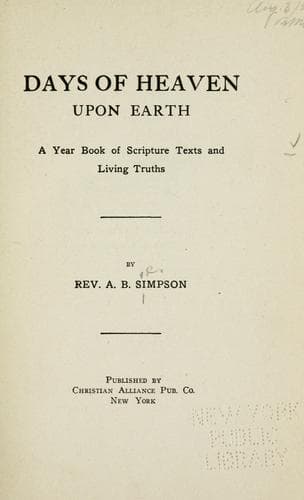
Days of Heaven Upon EarthSimpson, A. B. (Albert B.)
Religion
Days of Heaven Upon Earth
Simpson, A. B. (Albert B.)
Calendars; Devotional exercises
Have you ever learned the beautiful art of letting God take care of you,
and giving all your thought and strength to pray for others and for the
kingdom of God? It will relieve you of a thousand cares. It will lift you
up into a noble and lofty sphere, and teach you to live and love like God.
Lord save us from our selfish prayers and give us the faith that worketh
by love, and the heart of Christ for a perishing world.
FEBRUARY 7.
“Faithful in that which is least” (Luke xvi. 10).
The man that missed his opportunity and met the doom of the faithless
servant was not the man with five talents, or the man with two, but the
man who had only one. The people who are in danger of missing life’s great
meaning are the people of ordinary capacity and opportunity, and who say
to themselves, “There is so little I can do that I will not try to do
anything.” One of the finest windows in Europe was made from the remnants
an apprentice boy collected from the cuttings of his master’s great work.
The sweepings of the British mint are worth millions. The little pivots on
which the works of your watch turn are so important that they are actually
made of jewels. And so God places a solemn value and responsibility on the
humble workers, the people that try to hide behind their insignificance
the trifling opportunities and the single talents; and our littleness will
not excuse us in the reckoning day.
“Talk not of talents, what hast thou to do?
Thou hast sufficient, whether five or two.
Talk not of talents; is thy duty done?
This brings the blessing whether ten or one.”
FEBRUARY 8.
“We are not sufficient of ourselves to think anything as of ourselves”
(II. Cor. iii. 5).
Insufficient, “All sufficient.” These two words form the complement of
each other and together give the key to an efficient Christian life. The
discovery and full conviction of our utter helplessness is the constant
condition of spiritual supply. The aim of the Old Testament, therefore, is
ever to show man’s failure; that of the New, to reveal Christ’s
sufficiency. He has all things for us, but we cannot receive them till we
know that we have nothing.
The very essence, therefore, of Christian perfection is the constant
renunciation of our own perfection, and the continual acceptance of
Christ’s righteousness. And as we receive deeper views of our nothingness
and evil, it is but a call to claim more of His rich grace. But it is
possible fully to know our insufficiency and yet not take firmly hold of
His “all things.” This, too, must be done with a faith that will not
accept less than ALL. The prophet was angry because the king of Israel had
only smitten thrice upon the ground. He should have done it five or six
times. He might have had all. So let us meet His greatness and grace.
FEBRUARY 9.
“None of these things move me” (Acts xx. 24).
Public-domain text, read in full here on John Shaqi.
Reviews
Reviews
No reviews yet
Be the first to share your thoughts on this work.
Join the Discussion
Join the discussion
Sign in to leave a comment or review.
Sign InorCreate an account