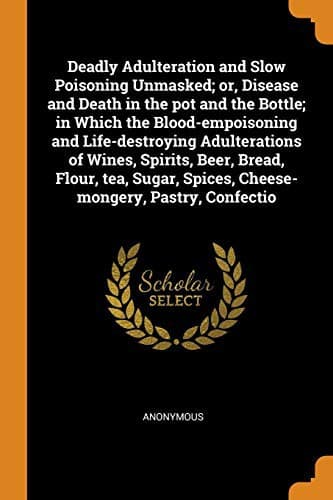
Deadly Adulteration and Slow Poisoning Unmasked: Disease and Death in the Pot and Bottle — John Shaqi
Deadly Adulteration and Slow Poisoning Unmasked: Disease and Death in the Pot and BottleAnonymous
Science
Deadly Adulteration and Slow Poisoning Unmasked: Disease and Death in the Pot and Bottle
Anonymous
Drug adulteration; Food adulteration and inspection
[G] The crusting of wine in the natural way generally takes place
in about nine months; but, among the artizans of the factitious
wine-trade, it is accomplished in a much shorter time. Those ingenious
gentry line the inside of the bottles they intend to fill with their
compound called wine, by suffering a saturated hot solution of
super-tartrate of potash, coloured red with a decoction of Brazil
wood, to crystallize within them. Others of that honest fraternity,
who dislike trouble, put a tea-spoon full of the powder of catechu
into each bottle, and by this artifice soon produce a fine crusted
appearance of “aged wine.” This simulation of maturity is often
accomplished by the humbler dealer by covering the bottles with snow,
or by exposing them to the rays of the sun, or by keeping them for a
few days in hot water. Where the casks are to be bottled off by the
purchaser, or in his presence, they are stained in the inside with the
artificial crystalline crust of super-tartrate of potash, as a proof of
the age of the wine.
[H] To produce the dilapidations of “Father Time” on wine corks,
the dry rot, however injurious to others, is of great advantage to
wine-dealers, as it soon covers the bottles with its mouldy appearance,
and consumes the external part of the cork; so that with a trifling
operation on the bottles after they are filled, and then deposited in
cellars pretty strongly affected with the dry rot, they can furnish the
admirers of “aged wine” with liquor having the appearance of having
been bottled seven or eight years, though it has not in reality been
there so many months. The staining of the lower extremities of the
corks with a fine red colour, produced from a strong decoction of
Brazil wood and alum, to make them appear “aged,” or as if they had
been long in contact with the wine, is another of the devices of the
factitious wine-trade, and forms a distinct branch of its operations.
SECTION III.
_Beer and Ale._
Public-domain text, read in full here on John Shaqi.
Reviews
Reviews
No reviews yet
Be the first to share your thoughts on this work.
Join the Discussion
Join the discussion
Sign in to leave a comment or review.
Sign InorCreate an account